

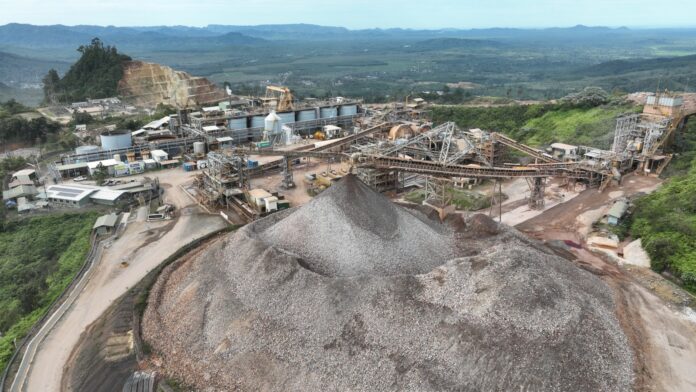
Ecobiz.asia – What initially appeared as a policy direction has now materialised into an administrative reality. The government’s plan to establish a new state owned mining entity, Perminas, and to transfer management of the Martabe gold mine from PT Agincourt Resources is no longer hypothetical. Public statements by senior officials, followed by formal corporate registration, indicate that the policy has moved decisively from discourse to execution readiness. The issue now extends beyond a single asset and raises fundamental questions about regulatory certainty, environmental governance, and procedural discipline in Indonesia’s mining framework.

On January 28, Danantara Chief Operating Officer Dony Oskaria confirmed that the Martabe mine would be transferred to Perminas, a newly established national mineral company operating directly under Danantara. He stated that the asset would not be handed to state owned mining holding MIND ID or its subsidiary PT Aneka Tambang Tbk, but instead managed through a new corporate vehicle created specifically for this purpose. Shortly thereafter, PT Perusahaan Mineral Nasional (Perminas) appeared in the AHU Online registry as a state owned limited liability company (Persero), with its registered address at Wisma Danantara Indonesia, Jakarta Selatan. This confirms that Perminas is not merely a policy concept, but a legally constituted entity prepared to assume operational control.
The broader debate emerged in the aftermath of severe flooding and landslides across parts of Aceh, North Sumatra, and West Sumatra in late November 2025, disasters that resulted in significant loss of life and widespread infrastructure damage. The government subsequently revoked forest utilisation permits held by 28 companies, citing findings by the Forest Area Regularisation Task Force (Satgas PKH) that linked forest violations to watershed degradation and heightened disaster impact. The state unquestionably holds the authority to enforce environmental and forestry law. However, in regulatory governance, the principle of post hoc non propter hoc remains relevant. Temporal sequence alone does not establish causation, nor does it replace the need for transparent, case specific findings.
Agincourt Resources, the operator of the Martabe gold mine, has historically operated under a valid Contract of Work, approved environmental impact assessments, and routine regulatory supervision. The company has stated publicly that it has not received formal written notification detailing the specific violations attributed to it. It has also pointed to its Green PROPER ratings from the Ministry of Environment and Forestry and multiple Good Mining Practice awards from the Ministry of Energy and Mineral Resources as evidence of regulatory compliance. While such recognitions do not immunise any operator from enforcement, they constitute a regulatory baseline that cannot be set aside without substantiated findings and due process.
The governance implications become more pronounced when the ownership structure of Agincourt Resources is fully considered. Agincourt Resources is a unit of PT United Tractors Tbk, a publicly listed company on the Indonesia Stock Exchange. United Tractors is a core subsidiary of Astra International, one of Indonesia’s largest industrial groups. Astra is controlled by Jardine Cycle and Carriage Limited, a Singapore listed company, which in turn forms part of the Jardine Matheson Group, a long established multinational conglomerate controlled by the Keswick family.
This layered ownership structure reflects long term institutional capital governed by capital market regulation, minority shareholder protections, and cross border legal obligations. The Martabe mine therefore sits within a framework that extends well beyond a single operating permit. Any intervention affecting operational control or economic rights has implications not only for the operator, but also for publicly listed entities, institutional investors, and contractual commitments across jurisdictions.
From a governance perspective, the distinction between environmental enforcement and asset transfer is material. Where violations are proven, established legal instruments exist, including suspension, mandated remediation, administrative sanctions, or closure pursuant to statutory mechanisms. Continuing the same mining operation under a different operator, particularly a newly formed state owned entity, introduces policy ambiguity. If an activity is deemed environmentally unacceptable, the legal response is to restrict or halt it, not to reassign it. In such circumstances, imperium sine lege nihil est. Power exercised without a clear and sequential legal foundation risks undermining institutional legitimacy.
Public communication has further amplified market sensitivity. Statements by Danantara leadership regarding the immediate role of Perminas were delivered while environmental investigations and administrative processes were still unfolding. The subsequent formalisation of Perminas as a Persero entity strengthens perceptions that operational outcomes may have been anticipated ahead of completed reviews. In administrative law, the principle of nemo iudex in causa sua remains instructive, particularly where the state appears positioned as both regulator and prospective beneficiary.
Industry response has reflected these concerns. The Indonesian Mining Association (API IMA) has urged the government to conduct a fair and objective review of Agincourt Resources, emphasising that companies widely regarded as compliant with Good Mining Practice and ESG principles should not be subject to abrupt and opaque interventions. The mineral and coal sector’s contribution of Rp138.37 trillion in state revenue in 2025 underscores the broader economic stakes tied to regulatory credibility.
International experience suggests that disputes tend to escalate where governments pursue operational continuity following permit revocation without transparent findings, procedural sequencing, or clarity on compensation mechanisms. Jurisdictions that prioritise verifiable evidence, institutional separation, and legal finality generally face lower legal, reputational, and fiscal exposure. Fiat iustitia in this context is not rhetorical. It is procedural.
At the policy level, Indonesia’s constitutional mandate over natural resources is not in question. The challenge lies in execution. Effective state participation in mining depends less on ownership structure than on governance clarity, legal coherence, and disciplined sequencing of administrative action.
The Martabe and Perminas developments therefore constitute a significant policy signal. The formal establishment of Perminas, combined with public confirmation of asset transfer before the completion of transparent environmental and administrative processes, risks setting an adverse precedent. It suggests a governance model where outcomes appear to precede findings. Indonesia retains the opportunity to reinforce confidence by aligning enforcement with due process, ensuring institutional separation, and restoring procedural credibility. In resource governance, credibility itself remains a strategic asset. ***