
Ecobiz.asia — Pertamina is strengthening the development of domestically sourced bioethanol through cross-sector collaboration to support the country’s E20 blending mandate targeted for 2028.
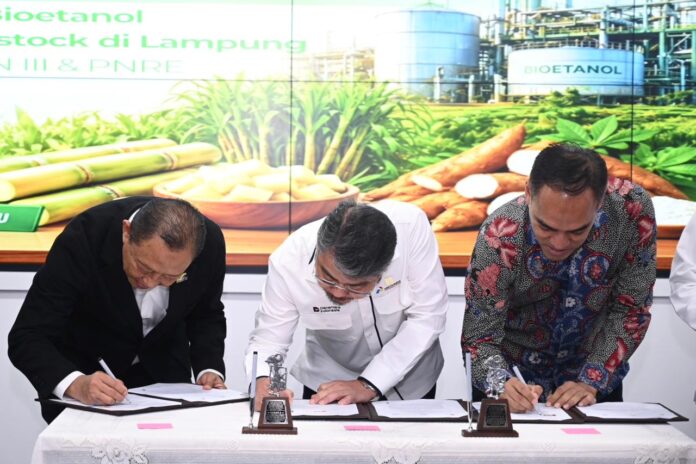
The commitment was marked by the signing of three memoranda of understanding (MoUs) involving Pertamina New & Renewable Energy (PNRE), PT Perkebunan Nusantara III, and Medco Energi Internasional through its subsidiary PT Medco Intidinamika in Jakarta on Monday (April 27, 2026).
The cooperation covers the revitalization of a multi-feedstock bioethanol plant in Lampung, the development of a new facility in Bone, South Sulawesi, and a molasses-based bioethanol plant in collaboration with PT Sinergi Gula Nusantara (SGN).
Director General of New, Renewable Energy and Energy Conservation at the Energy and Mineral Resources Ministry, Eniya Listiani Dewi, said accelerating bioethanol implementation requires stronger supply and infrastructure.
“The E20 target by 2028 requires a major leap in both production and infrastructure. Collaboration is key to ensuring supply availability and building an integrated ecosystem,” she said.
The partnership brings together complementary roles, with PTPN III supplying plantation-based feedstock, Medco supporting industrial and infrastructure development, and Pertamina—through PNRE—driving downstream utilization of bioethanol as a clean energy source.
Pertamina’s Director of Transformation and Business Sustainability, Agung Wicaksono, said bioethanol development is a strategic step to strengthen energy security amid global uncertainty.
“Utilizing domestic energy resources is crucial. This collaboration opens the path for import substitution while reinforcing national energy independence,” he said.
Pertamina NRE CEO John Anis noted that Indonesia’s bioethanol demand to meet the E20 target is projected to reach 3–5 million kiloliters by 2028, requiring the development of production facilities across regions based on local resource potential.
Meanwhile, PTPN III President Director Denaldy Mulino Mauna said bioethanol development will also generate economic benefits, including market certainty for farmers and improved supply stability for industry.
“This is not just a project, but an effort to build an integrated bioethanol ecosystem from upstream to downstream,” he said.
Pertamina has previously developed several bioethanol initiatives, including a plant in Glenmore, Banyuwangi, collaboration with Toyota Tsusho in Lampung, and a pilot project based on sugar palm in Garut. ***