
Ecobiz.asia — Indonesia is preparing to operationalize a forestry carbon nesting framework to support high-integrity transactions and attract global investment into its carbon market.
Director General of Sustainable Forest Management at the Ministry of Forestry, Laksmi Wijayanti, said regulatory clarity is key to ensuring market certainty while unlocking financing for forest managers and local communities.
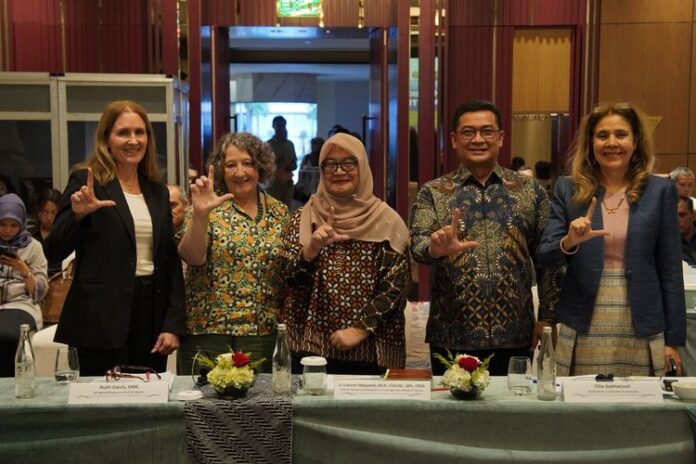
“As a global leader in forest carbon, Indonesia is committed to delivering integrated solutions through a credible nesting framework. This is not only about climate ambition, but also about providing certainty for investors and tangible benefits for local communities,” she said at a high-level dialogue in Jakarta on Wednesday (April 22, 2026).
Nesting refers to a mechanism that aligns greenhouse gas (GHG) mitigation planning and implementation across national, provincial, and project levels. The approach is designed to prevent double counting and double claims of carbon units, while ensuring transparency and environmental integrity in line with international standards.
In practice, the framework will be applied to jurisdictional-based climate mitigation programs and carbon trading schemes implemented at national and subnational levels.
The initiative supports Indonesia’s FOLU Net Sink 2030 target, which aims to achieve a net carbon sink of 140 million tonnes of CO₂ equivalent by 2030 through measures such as deforestation control, mangrove restoration, and sustainable peatland management.
Initial implementation will take place in Riau province under the GREEN for Riau initiative, supported by the UN-REDD Programme and funding from the UK government. The province holds significant carbon reserves, particularly from its approximately 3.5 million hectares of peatland.
Director of Forest Utilization Business Development at the Ministry of Forestry, Ilham, said the framework is expected to strengthen Indonesia’s pathway toward its net zero emissions target by 2060.
“Our challenge is no longer ambition, but operationalizing the framework on the ground so that emission reductions are measurable, transparent, and capable of mobilizing large-scale private financing,” he said.
International partners have also expressed support. UK Nature Envoy Ruth Davis said Indonesia has one of the world’s largest forest carbon potentials and could attract sustainable investment if market integrity is maintained.
Norwegian Ambassador to Indonesia Rut Krüger Giverin echoed the view, noting that a clear nesting framework is essential to building trust in global carbon markets.
Despite a strong regulatory foundation, businesses are still awaiting clarity on implementation. UN Resident Coordinator in Indonesia Gita Sabharwal said the next phase will depend on consistent policy execution.
“Indonesia’s progress will be closely watched by global markets and buyers of high-integrity carbon credits. This presents an opportunity to set a global benchmark for jurisdictional forest climate action,” she said. ***