

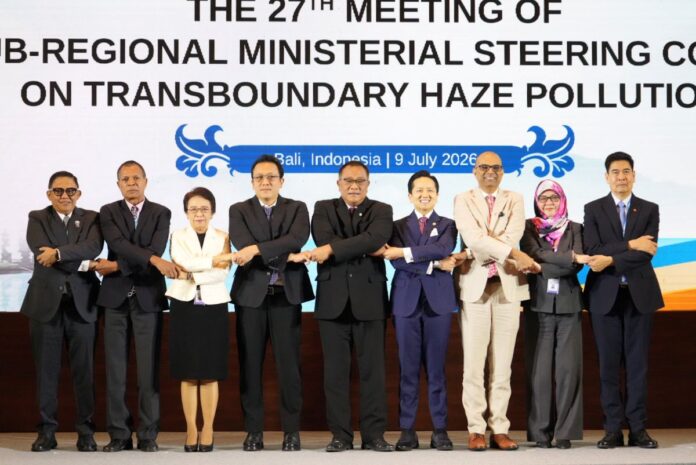
Ecobiz.asia — ASEAN environment ministers have reaffirmed their commitment to strengthening regional preparedness against forest fires and transboundary haze as the region faces an increased risk of prolonged dry conditions linked to El Niño and climate change.
The commitment was made during the 27th Meeting of the Sub-Regional Ministerial Steering Committee (MSC) on Transboundary Haze Pollution, held in Bali on Thursday (July 9, 2026). The meeting brought together ministers and senior officials from Brunei Darussalam, Indonesia, Malaysia, Singapore, Thailand, Timor-Leste, and the ASEAN Secretariat.
Chaired by Indonesia’s Minister of Environment and Head of the Environmental Control Agency, Mohammad Jumhur Hidayat, the meeting reviewed the implementation of the ASEAN Agreement on Transboundary Haze Pollution (AATHP) and discussed measures to strengthen regional coordination ahead of a potentially more severe dry season.
Jumhur said climate change requires ASEAN countries to enhance early warning systems, monitoring, coordination, and rapid response mechanisms to reduce the risk of forest and land fires.
“The potential impact of the El Niño phenomenon serves as a reminder for ASEAN to remain vigilant and continue strengthening preparedness, coordination, early warning systems, monitoring, and rapid response,” he said.
Indonesia also presented its latest wildfire prevention measures, including the reactivation of the 2026 National Forest and Land Fire Coordination Desk, the declaration of emergency preparedness status in five fire-prone provinces, expanded technology-based joint patrols, stronger community awareness programs, and ground and aerial firefighting operations, including water bombing and weather modification.
The meeting also reviewed progress on the establishment of the ASEAN Coordinating Centre for Transboundary Haze Pollution Control (ACCTHPC). Indonesia reported advances in its domestic ratification process, the preparation of operational documents, and the development of office facilities and monitoring technology to support the center’s future operations.
ASEAN delegates welcomed Indonesia’s progress in preparing the coordinating center and encouraged member states to expedite ratification procedures so that the ACCTHPC can become fully operational in supporting regional haze prevention, monitoring, information sharing, and emergency response.
Malaysia’s Minister of Natural Resources and Environmental Sustainability, Dato’ Sri Arthur Joseph Kurup, emphasized the importance of preventive action through field monitoring, early intervention in high-risk areas, and rapid suppression of fire hotspots before they escalate into large-scale wildfires.
Meanwhile, ASEAN Deputy Secretary-General for the ASEAN Socio-Cultural Community, San Lwin, warned that El Niño could result in a longer and drier dry season this year, underscoring the need for stronger regional cooperation.
The 27th MSC meeting, held alongside the Technical Working Group on Transboundary Haze Pollution, concluded with member states reaffirming their commitment to strengthen collective action through enhanced coordination, early warning systems, monitoring, information exchange, and rapid response to prevent forest fires and transboundary haze across the region. ***