

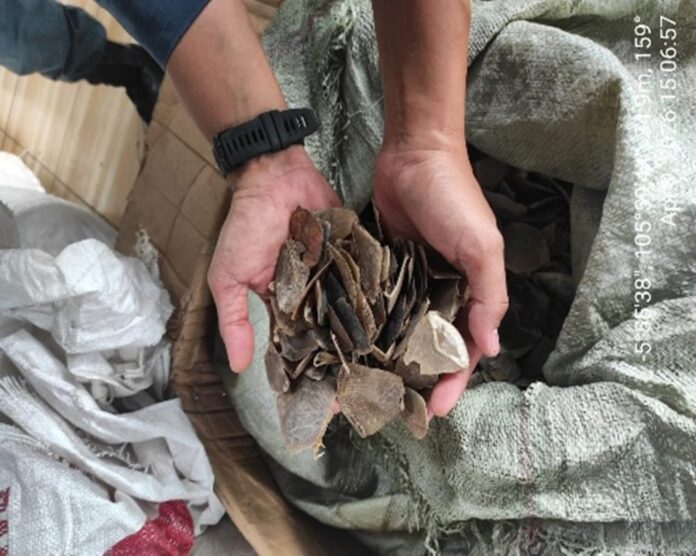
Ecobiz.asia — Indonesia’s Forestry Ministry has arrested a Vietnamese national identified as LVP over the smuggling of 796.34 kilograms of pangolin scales at Merak Port, Banten.
The operation was carried out by the ministry’s Forest Law Enforcement Unit (Gakkum) for the Java, Bali, and Nusa Tenggara region after authorities received a handover of the Vietnamese-flagged cargo vessel MV Hoi An 8 from the Banten Naval Base.
Head of the regional Gakkum office Aswin Bangun said the case reflects increasingly sophisticated methods used in illegal wildlife trafficking.
“We are not only focusing on the suspect already detained, but also tracing the patterns, routes, and networks involved in this case,” he said in a statement on Monday (April 13, 2026).
The vessel was officially carrying around 2,735 tons of steel coils, but authorities discovered 26 packages of pangolin scales concealed among the legal cargo.
Investigators have questioned 13 crew members and named LVP as a suspect. The case is believed to be part of a transnational illegal wildlife trade network using maritime smuggling routes.
Authorities are also probing the possible use of transshipment or ship-to-ship transfer methods at sea, including the use of floating drop-off points to obscure the origin and distribution routes of the contraband.
The seized scales are estimated to represent the killing of a large number of pangolins. The Javan pangolin is a protected species classified as critically endangered, making the case a serious threat to biodiversity conservation.
The suspect has been charged under Article 40A (1)(f) in conjunction with Article 21 (2)(c) of Law No. 32/2024 on Conservation of Biological Natural Resources and Ecosystems, carrying a maximum penalty of 10 years’ imprisonment and a fine of up to Rp5 billion.
Forestry Law Enforcement Director General Dwi Januanto Nugroho said the case underscores that illegal wildlife trafficking remains a serious and organized threat.
“This case highlights the need to strengthen prevention systems. Wildlife protection must not only focus on habitats, but also on all potential trafficking routes,” he said. ***