

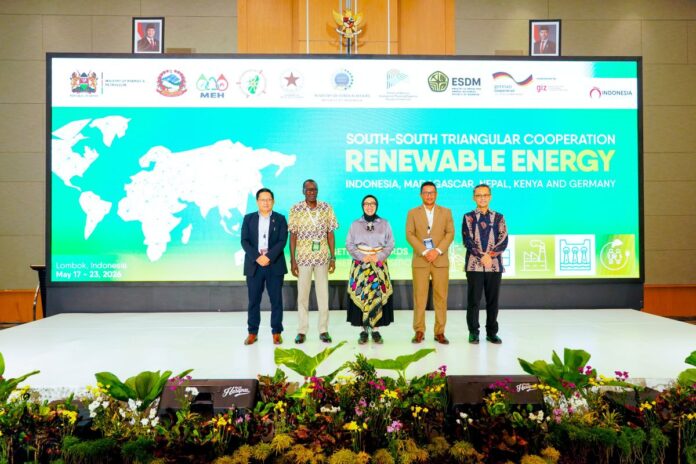
Ecobiz.asia — Developing countries are strengthening collaboration on renewable energy development, technology transfer, and capacity building through the South-South and Triangular Cooperation on Renewable Energy (SSTC RE) forum held in Lombok, West Nusa Tenggara, from May 19–23, 2026.
The forum brought together representatives from Indonesia, Madagascar, Nepal, Kenya, and Germany to accelerate an inclusive and sustainable energy transition through cross-country cooperation and multi-stakeholder partnerships.
Discussions at the SSTC RE forum covered a range of strategic clean energy issues, including micro-hydropower, grid integration, waste-to-energy, biomass, energy efficiency, geothermal development, and renewable energy systems for small islands such as Lombok.
The event involved governments, academics, NGOs, state-owned enterprises, and private sector participants as part of broader efforts to strengthen global collaboration in accelerating the clean energy transition.
Director General of New, Renewable Energy and Energy Conservation (EBTKE) at Indonesia’s Ministry of Energy and Mineral Resources, Eniya Listiani Dewi, said the energy transition has become not only an environmental agenda but also a strategic pathway to strengthen energy security and economic resilience.
“Indonesia views the energy transition not only as an environmental agenda, but also as a strategic pathway to strengthen energy security, economic resilience, and public welfare. Therefore, international collaboration is essential to accelerate inclusive and sustainable renewable energy development,” Eniya said in her remarks, as quoted on Saturday (May 23, 2026).
Eniya said Indonesia has renewable energy potential of around 3,687 gigawatts (GW), sourced from solar, hydropower, geothermal, wind, bioenergy, and ocean energy. The government continues to expand renewable energy deployment through rooftop solar programs, floating solar plants, biofuel development, and sustainable aviation fuel (SAF).
Indonesia is also preparing to implement its B50 biodiesel program starting July 1, 2026, following a series of automotive and non-automotive trials.
During the forum, participating countries exchanged experiences and best practices in renewable energy development. Indonesia shared lessons on micro-hydropower development with Madagascar, grid integration with Nepal, and geothermal development with Kenya.
Principal Advisor of ENTRI-GIZ Indonesia ASEAN, Catoer Wibowo, said South-South and triangular cooperation has expanded significantly since 2023, with more than 300 coordination activities involving 665 personnel and 143 institutions.
“The meeting in Lombok is not only a reaffirmation of the commitments that have been built, but also an opportunity to strengthen partnerships, encourage inclusive dialogue, and deliver concrete steps to reduce energy inequality and accelerate a just energy transition,” Catoer said.
Meanwhile, Acting Director General of Kenya’s Energy and Petroleum Regulatory Authority (EPRA), Joseph Odongo Oketch, highlighted the importance of cooperation between Kenya and Indonesia in geothermal energy development.
“Kenya is one of the world’s largest geothermal producers, and Indonesia ranks next. We have established a partnership with Indonesia to learn how to improve the management of our geothermal resources,” he said.
From Nepal, President of the Renewable Energy Confederation of Nepal (RECON), Kushal Gurung, expressed interest in expanding collaboration with Indonesia in the micro-hydropower and waste-to-energy sectors, including renewable energy technology transfer.
Meanwhile, Executive Secretary of Madagascar’s Rural Electrification Development Agency (ADER), Joelinet Vanomaro, said the forum could create opportunities for educational cooperation and academic exchanges between universities in participating countries.
Eniya emphasized that achieving a successful energy transition requires broad participation from governments, academia, industries, civil society organizations, media, and local communities.
“Through strong cooperation and collaboration, we can accelerate technology development, enhance human resource capacity, and expand the benefits of clean energy for society toward a more sustainable and inclusive energy future,” she said. ***