
Ecobiz.asia – Indonesia is positioning forestry carbon trading as a financing instrument to support the country’s climate targets, rather than merely as a marketplace for buying and selling carbon credits.
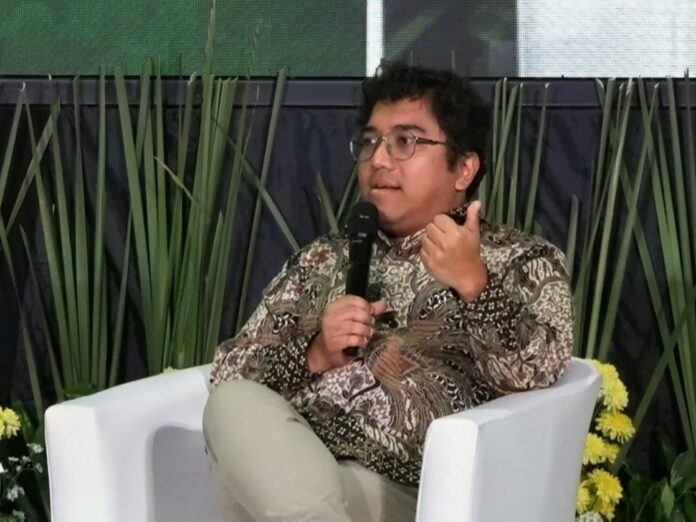
Edo Mahendra, Principal Advisor to the Minister of Forestry for carbon trading, said Minister of Forestry Regulation (Permenhut) No. 6/2026 on carbon trading through greenhouse gas emission offsets in the forestry sector should be understood as part of a wider effort to build a carbon ecosystem and unlock multiple sources of climate finance.
“The final objective is not to sell, but to build an ecosystem. What ecosystem? A carbon ecosystem. Carbon can be used, and this is an instrument. This is not the endgame,” Edo said during a discussion on the issuance of the regulation on Wednesday (April 29, 2026).
“This is an instrument so that our environmental target aspirations can be achieved. There are many channels, and do not think of this as a single silver bullet,” he added.
Edo said the spirit of Presidential Regulation No. 110/2025, which serves as the basis for the forestry carbon regulation, is to open all potential climate financing channels that Indonesia can optimize.
He said carbon trading should be seen alongside other funding sources, including state budgets, regional budgets, internal finance, external finance, results-based payments, the Joint Crediting Mechanism, Article 6 mechanisms, and other financing options.
“The spirit of Presidential Regulation No. 110 is to open all potential climate financing channels that Indonesia can optimize. Therefore, there needs to be shared responsibility from every sector, so that we can work on this together,” he said.
Edo said Indonesia’s climate targets require each sector to take ownership of its own contribution, including in the forestry sector. He said the framework is intended to create agency, responsibility, and clarity over how each sector will contribute to national environmental targets.
“Each sector must have agency and ownership, which also comes with responsibility for achieving their respective targets,” he said.
He said the broader carbon economic value framework is built around three main principles: synergy, deregulation, and decentralization. Synergy, he said, is needed to align Indonesia’s environmental ambitions with broader development goals, while deregulation is intended to make participation in carbon-related activities easier for different actors.
“The first point is the importance of ensuring synergy. Synergy between our environmental target aspirations and our broader development aspirations,” Edo said.
“The second point is the spirit of deregulation. This is important because we want to ensure that business processes for every element in Indonesia, from the government and private sector to communities and indigenous communities, can be carried out as simply as possible,” he said.
Edo said deregulation also means openness to various carbon market pathways, channels, and instruments. He said Indonesia hopes its own carbon certification instrument (SPE) can eventually gain international acceptance, while non-SPE mechanisms may also be accommodated as long as they meet high-quality and high-integrity standards.
“One of the spirits of deregulation is openness. Our openness to various available pathways, channels, and instruments,” he said.
“If it is our own instrument, we must make it easier for our own instrument. We hope that our SPE can be internationally accepted in the future. If people want to work on it, please go ahead. What about non-SPE mechanisms? That is also fine. We open everything. What matters is that we pursue this step by step with high quality and high integrity,” Edo said.
Director General of Sustainable Forest Management Laksmi Wijayanti reinforced the financing angle, saying carbon credits or carbon units generated from forestry-sector climate mitigation actions should be viewed as part of the broader goods and services business model in forestry.
“I want to clarify that carbon credits or carbon units generated from climate change mitigation actions in the forestry sector are also part of the goods and services business model in forestry activities,” Laksmi said in the same occasion. ***