
Ecobiz.asia — Singapore and the Philippines have signed an implementation agreement on carbon credit collaboration under Article 6 of the Paris Agreement, marking the Philippines’ first such bilateral deal and a milestone for regional carbon market development.
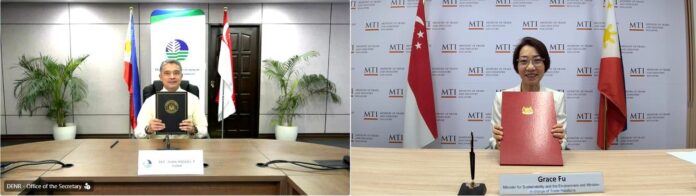
The agreement was signed during ASEAN Climate Week in Manila by Singapore’s Minister for Sustainability and the Environment Grace Fu and the Philippines’ Environment Secretary Juan Miguel T. Cuna.
The legally binding framework enables the generation and international transfer of high-integrity carbon credits from mitigation projects aligned with Article 6 rules. It is expected to provide clarity for project developers and support the development of carbon markets in the region.
Grace Fu said the agreement reflects deepening bilateral cooperation and opens new opportunities for businesses and communities.
“This agreement will channel climate finance towards impactful projects in the Philippines and unlock new opportunities in carbon markets for businesses and local communities,” she said in a statement as quoted on Monday (May 4, 2026).
Philippines Environment Secretary Juan Miguel T. Cuna described the deal as a strategic step to advance climate action and sustainable development.
“The agreement reflects rigorous technical work and a shared ambition to operationalise high-integrity climate cooperation under the Paris Agreement,” he said.
The collaboration is expected to direct financing into emissions reduction projects in the Philippines, supporting sustainable development through job creation, improved energy security, and reduced environmental pollution.
Under the agreement, correspondingly adjusted carbon credits can be used for multiple purposes, including compliance with national climate targets and international mechanisms such as the Carbon Offsetting and Reduction Scheme for International Aviation (CORSIA).
Singapore also committed to channel 5% of proceeds from authorised carbon credits to climate adaptation efforts in the Philippines and to cancel 2% of credits at issuance to contribute to a net reduction in global emissions.
The agreement is part of broader efforts by both countries to advance carbon market mechanisms and support regional climate cooperation under the Paris Agreement. ***