

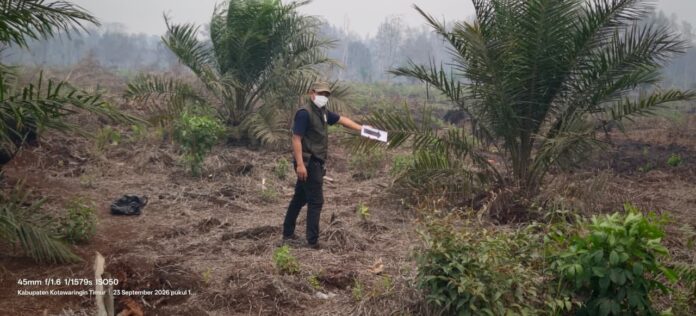
Ecobiz.asia – The Roundtable on Sustainable Palm Oil (RSPO) has rejected claims that oil palm plantations are the main source of forest and land fires in Indonesia, saying satellite data show that only a small proportion of detected hotspots are located within its members’ concessions. The organization also raised the possibility of deliberate burning by unidentified individuals.
Aryo Gustomo, RSPO director of assurance, said the organization’s monitoring recorded around 2,500 hotspots within RSPO member concessions in August, compared with approximately 126,000 hotspots across Indonesia and Malaysia.
“That is a very small proportion, only around 1–3%,” Aryo said during a public discussion on forest fires, ecosystem protection and sustainable palm oil in Jakarta on Friday (Oct. 30, 2026).
He cautioned that satellite-detected hotspots do not necessarily indicate confirmed fires, stressing that each detection requires ground verification to establish whether a fire has actually occurred.
Aryo also cited data from Nusantara Atlas, which he said showed that nearly 90% of the 1.9 million hectares of land burned in Indonesia between January and September 2026 were outside oil palm plantation concessions.
According to Aryo, some confirmed fires were linked to community activities or fires spreading from neighboring concessions. He also alleged that some incidents might have involved deliberate burning by unidentified individuals.
“Interestingly, a small number are also suspected to involve sabotage. These are cases where unidentified individuals deliberately set fires, with one report even attributing a fire to a cigarette butt,” he said.
RSPO said it enforces a zero-burning policy under its 2024 Principles and Criteria, which prohibits the use of fire for land clearing and requires protection of peatlands and High Conservation Value (HCV) areas.
The organization also uses its FireWatch satellite monitoring system to detect hotspots and operates an independent complaints mechanism through which stakeholders can report alleged violations. Complaints are recorded in a publicly accessible database.
Companies found to have violated RSPO standards may face corrective action requirements, certificate suspension or termination of membership, depending on the findings.
Aryo said allegations of non-compliance must be investigated and supported by evidence before sanctions are imposed on members. He added that preventing recurring fires requires cooperation among governments, plantation companies, local communities and civil society organizations.
Global palm oil industry stakeholders are scheduled to gather in Jakarta for the RSPO’s annual Roundtable Conference (RT2026) on Nov. 3–4, 2026. ***