
Ecobiz.asia – Indonesia has an important role to play in shaping a high-integrity biodiversity credit market that can be scaled globally, according to Dame Amelia Fawcett, Co-Chair of the International Advisory Panel on Biodiversity Credit (IAPB).
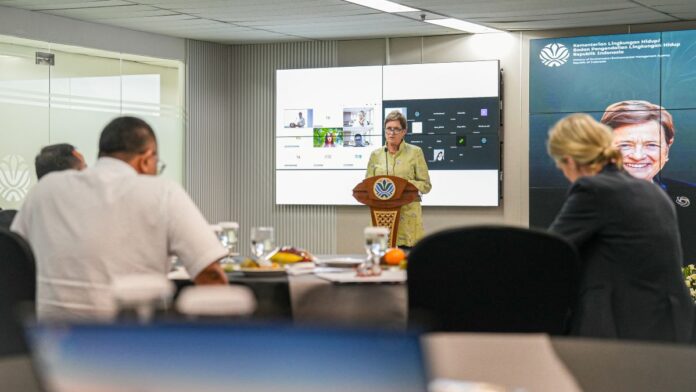
“Indonesia has an important role in shaping a high-integrity biodiversity credit market that can be developed at scale, including globally,” Amelia said at the International Workshop on Biodiversity Credit Implementation in Jakarta on Tuesday (Sept. 15, 2026).
She said a properly designed and regulated biodiversity credit market could mobilize private financing for conservation and restoration, support local livelihoods and strengthen the green economy.
The Indonesian government is currently developing biodiversity credits as a conservation financing instrument based on three principles: scientific integrity, social inclusion and transparent governance.
Minister of Environment and head of the Environmental Control Agency Moh Jumhur Hidayat said the three principles would serve as the foundation for Indonesia’s biodiversity credit framework.
“Indonesia views the development of biodiversity credits as needing to be built on three main principles: scientific integrity, social inclusion and transparent governance,” Jumhur said at the workshop.
The development of the instrument requires a policy foundation, operational guidelines and regulatory arrangements tailored to Indonesia’s ecological, socio-economic and cultural conditions, as well as its institutional landscape.
On the social side, the Ministry of Environment and the Environmental Control Agency places local and Indigenous communities at the center of biodiversity credit development. The communities are seen as both stewards of nature and holders of traditional knowledge relevant to biodiversity management.
The government is also encouraging private-sector participation through green investment to support community-based conservation. Economic benefits generated from nature conservation, it said, should be shared fairly with those involved in protecting ecosystems.
The workshop also provided a platform for Indonesia to exchange experience in developing a national biodiversity credit framework and strengthen international cooperation in support of the Kunming-Montreal Global Biodiversity Framework.
Discussions also focused on preparations for the 17th Conference of the Parties to the Convention on Biological Diversity (CBD COP17) in Armenia. ***