
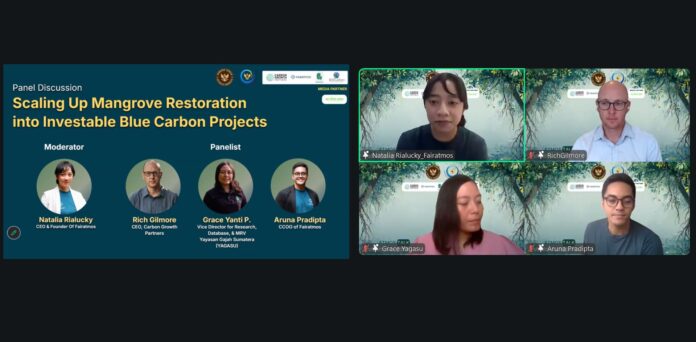
Ecobiz.asia – Project developers and asset owners in Indonesia still face significant challenges in developing blue carbon projects, particularly in the early stages of project assessment and implementation.
Aruna Pradipta, Chief Commercial and Operating Officer (CCOO) of Fairatmos, said one of the main bottlenecks lies in the initial eligibility assessment, especially for mangrove areas managed by local and vulnerable communities.
“A lot of mangrove assets in Indonesia are managed by communities with limited access to knowledge on carbon projects and financing. Many simply don’t know where to start or how to determine whether their area is eligible,” Aruna said during the Atmos Talk webinar hosted by Fairatmos on Thursday (March 26, 2026).
He noted that despite Indonesia’s vast blue carbon potential, only a small portion of land is actually suitable for carbon project development. In many cases, only 10–30% of a given area can be considered eligible or creditable.
“This raises questions about whether a project is economically viable and operationally feasible, which is a key concern for developers,” he said.
Beyond eligibility, Aruna pointed to implementation as another major hurdle. Mangrove restoration is technically complex, with higher upfront costs and risks compared to land-based reforestation.
Developers must consider multiple factors, including land suitability, appropriate species selection, seedling availability, and long-term environmental risks such as sea level rise.
“There are many uncertainties. For example, whether the area being restored today will still exist in 20 to 30 years due to climate change,” he said.
To address these challenges, Fairatmos has developed digital tools aimed at improving access to information and accelerating early-stage project assessment.
Since 2022, the company has engaged with more than 800 projects and assessed over 80 million hectares of land across the region.
One of the tools includes a Southeast Asia carbon methodologies database, which allows users to identify and compare applicable carbon standards and methodologies for specific project types, including blue carbon.
Another tool enables project developers to assess the eligibility, carbon potential, and revenue potential of a land area by uploading spatial data into the platform.
The system analyzes land cover, land use status, and regulatory classifications to determine whether a project meets the requirements for carbon credit development.
“These tools are designed to democratize access to knowledge and help project developers and communities understand what to expect when exploring carbon projects,” Aruna said. ***