

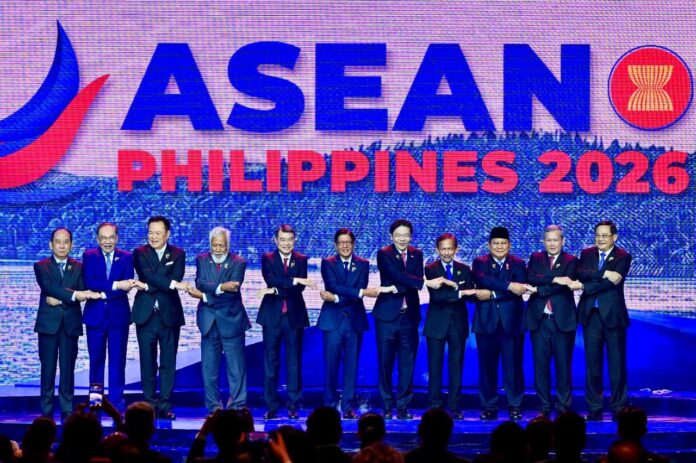
Ecobiz.asia — Indonesian President Prabowo Subianto urged ASEAN countries to accelerate energy diversification as rising geopolitical tensions and disruptions to global trade and energy supply chains continue to pressure regional energy security.
Speaking during the plenary session of the 48th ASEAN Summit at the Mactan Expo in Cebu, Philippines, on Friday (May 8, 2026), Prabowo warned that prolonged disruptions along major global trade and energy routes were creating significant challenges for ASEAN economies.
“Prolonged disruptions along major global routes are already putting tremendous pressure on our countries’ energy situation, and that pressure does not appear likely to ease anytime soon,” the President said.
Prabowo stressed that ASEAN must strengthen its energy resilience proactively rather than reactively in response to evolving global crises.
“ASEAN must be prepared for long-term disruptions. Our resilience must be built proactively with a clear and forward-looking approach,” he said.
According to Prabowo, energy diversification has become an urgent necessity for the region, with ASEAN countries needing to move faster in expanding alternative and renewable energy sources.
“Energy diversification is no longer an option. It is essential, it is necessary. We must move faster. We must pursue alternative sources and prepare renewable energy,” he said.
During the summit, Prabowo outlined several measures Indonesia is currently pursuing to strengthen national energy security, including bioenergy development, wider adoption of electric vehicles, and a large-scale solar energy program.
“We are developing alternatives and renewable energy, utilizing bioenergy, increasing the use of electric vehicles, and building a very ambitious 100-gigawatt solar energy program that we aim to complete within three years,” he said.
Accompanying the President at the summit, Indonesian Energy and Mineral Resources Minister Bahlil Lahadalia said solidarity among Southeast Asian countries would be critical to maintaining regional energy security amid growing global uncertainty.
According to Bahlil, energy diversification is necessary to reduce dependence on a single energy source during periods of global supply disruption.
“The global energy situation is currently highly uncertain. We must diversify our energy sources so that when one source becomes difficult to obtain, we still have other alternatives,” Bahlil said in Cebu.
He added that Indonesia holds a strategic position due to its vast renewable energy potential. The government is currently prioritizing the development of a 100-gigawatt solar power program, increasing the biodiesel blending mandate toward B50, and accelerating electric vehicle adoption. ***