

Ecobiz.asia — Indonesia and Britain agreed to step up climate cooperation to accelerate post-COP30 action, with a focus on climate finance, national resilience and nature-based solutions, Indonesian officials said on Friday.
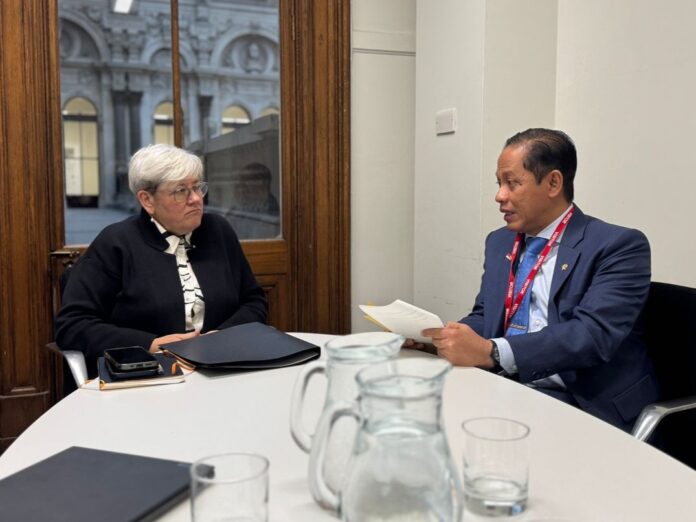
The commitment was underscored during a bilateral meeting in London between Indonesia’s Environment Minister, Hanif Faisol Nurofiq, and the UK’s Special Representative for Climate, Rachel Kyte on Friday (Jan. 22, 2026).
Hanif said outcomes from the COP30 climate summit in Belém, Brazil, fell short of the urgency required to address the escalating climate crisis, particularly in mobilising finance for adaptation and loss and damage.
“From our perspective, collective progress at COP30 has not matched the scale of the climate emergency. Much more concrete action is needed, especially on climate finance and operational guidance for implementation,” Hanif said.
He said Indonesia, as a climate-vulnerable developing country, was already facing severe impacts, citing recent floods and landslides in parts of Sumatra.
“Flooding and landslides in Aceh, North Sumatra and West Sumatra have killed more than 1,000 people, displaced hundreds of thousands and caused significant economic losses. This highlights the urgency of strengthening climate risk analysis, early warning systems and preparedness,” he said.
Data from Indonesia’s National Disaster Mitigation Agency (BNPB) showed total losses from the disasters exceeded $3.1 billion.
Indonesia also stressed the importance of nature-based solutions as a core component of its climate adaptation and mitigation strategy.
“Nature-based solutions deliver multiple benefits for adaptation, mitigation, biodiversity and community resilience, but their implementation requires strong technical capacity, robust data and high-integrity financing mechanisms,” Hanif said.
Both countries agreed to use the UK–Indonesia Strategic Partnership as a framework for further technical cooperation, including on high-integrity carbon systems, early warning systems, high-resolution spatial data and rapid assessment tools for landscape resilience.
The meeting reaffirmed Indonesia’s and Britain’s commitment to maintaining an active role in global climate leadership while aligning international climate agendas with national resilience priorities and the protection of vulnerable communities. ***