
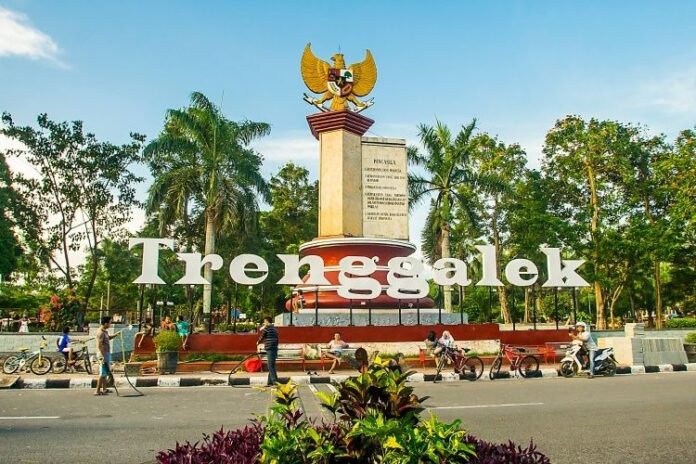
Ecobiz.asia — The Trenggalek regency administration in East Java is developing a “waste to coin” concept that seeks to turn household waste into an economic asset while encouraging community participation in waste management. Trenggalek Regent Mochamad Nur Arifin said the initiative is designed as part of a decentralized circular economy ecosystem, in which waste is treated as a resource rather than a problem. “We in Trenggalek bring the concept of waste to coin,” Nur Arifin said during Electricity Connect 2026 on Thursday.
He said the approach is intended to reduce local government dependence on budgets and tipping fees to manage waste. “I am against government dependency on budget to tackle or solve the problem of waste. I am against the concept of tipping fee,” he said.
According to Nur Arifin, relying on government budgets and tipping fees could make waste-management solutions difficult to sustain, particularly when local government fiscal capacity is limited. He said the conventional approach of increasing waste-related taxes or retribution could also create the perception among residents that they can continue polluting as long as they pay the government to handle the waste. Instead, Trenggalek is seeking to create economic incentives for communities to sort waste properly, starting with students.
Under the program, students receive incentives in the form of digital “coins” when they properly sort and bring waste to schools. The program is known locally as Sangu Sampah, or waste pocket money. “Every coin has a number of rupiah in it. So, we call the program in Indonesia Sangu Sampah. Every student has pocket money from every waste that they bring to the school,” Nur Arifin said.
He said the system has been developed using Web3 technology and blockchain, with waste-related data recorded on a shared digital ledger designed to improve transparency and prevent manipulation. Once waste has been properly separated, he said, it can be channelled more efficiently to downstream processing facilities.
The waste could subsequently be processed into energy, including refuse-derived fuel (RDF), while recyclable materials such as plastics could be recovered. Electronic waste could also be processed to recover valuable minerals, including gold.
Nur Arifin said the value of the digital coin would be linked not only to the intrinsic economic value of the waste but also to its potential carbon value.
“The value of the coin has the intrinsic value, which is the value of the waste that we manage. And also, the price of the carbon,” he said. He added that waste management could generate carbon credits by reducing greenhouse gas emissions from waste.
Nur Arifin cited Trenggalek’s baseline data showing that waste contributes around 60% of the regency’s greenhouse gas emissions. Improving waste management, therefore, could potentially generate measurable emission reductions that could be accounted for as carbon credits.
“If we can manage [waste] properly, I can claim the reduction of greenhouse gases that are released. So, I can count it as carbon credit,” he said. In the longer term, Nur Arifin said the administration hopes that as the ecosystem grows, the coin could potentially be brought into a wider market, with its value supported by the growing volume of managed waste and associated carbon assets.
He said the initiative is also intended to create a longer-term economic and educational legacy beyond his tenure as regent. “Even though my term is already done, at least I could say to my people, since you are a student, you already have a coin, and the coin will be your investment for the future,” he said. According to Nur Arifin, the program has two main objectives: educating the younger generation to take responsibility for waste and creating an ecosystem that can generate jobs, improve people’s quality of life and strengthen the local economy. “Your waste is your resources. The waste is the tools for your investment in the future,” he said. ***