
Ecobiz.asia — Indonesia’s Financial Services Authority (OJK) has unveiled plans to revise the country’s carbon exchange regulations, including the adoption of blockchain-based registry technology and integration with the national carbon registry system, in a move aimed at accelerating carbon market growth and improving transparency.
The planned revision was presented to Commission XI of Indonesia’s House of Representatives during a parliamentary hearing at the Parliament Complex in Jakarta on Thursday (May 21, 2026).
The regulatory update follows the issuance of Presidential Regulation No. 110/2025 on carbon pricing implementation, which requires adjustments to OJK Regulation No. 14/2023 governing carbon trading through the carbon exchange.
Friderica Widyasari Dewi, Chair of OJK’s Board of Commissioners, said the revision is being prepared in coordination with multiple ministries and government agencies to prevent double counting in carbon trading transactions.
“As a result, the issuance process will become faster,” Friderica, widely known as Kiki, said.
According to her, one of the key changes in the revised regulation is the strengthening of a decentralized carbon registry system using technologies including blockchain.
The technology is expected to allow market participants to directly access transaction data and carbon unit records in real time, improving market transparency and traceability.
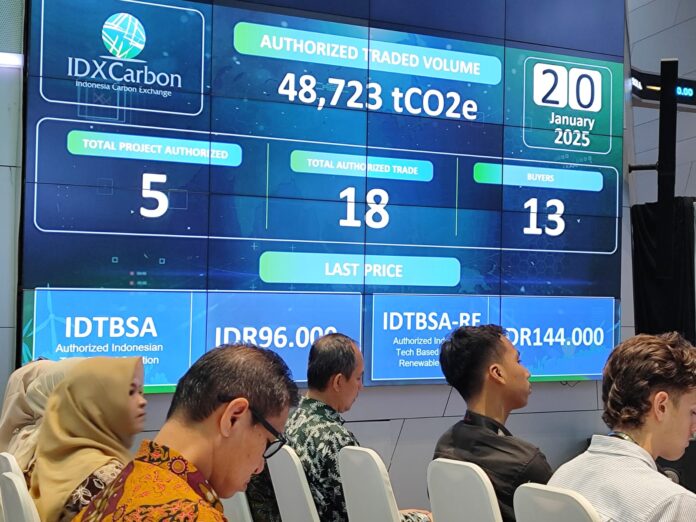
OJK and related government institutions are also developing the Carbon Unit Registry System (SRUK), which will be directly connected to carbon trading platforms such as IDXCarbon.
“This Carbon Unit Registry System (SRUK) will be connected to the carbon exchange platform, making the process easier and hopefully accelerating carbon trading growth so the market can become significantly larger,” Friderica said.
OJK data shows that carbon trading transactions in Indonesia currently remain relatively small, totaling around Rp98.7 billion (approximately US$6 million).
However, the regulator believes the revised rules and integrated trading infrastructure could become a catalyst for expanding the domestic carbon market.
“With these revisions, we expect transaction values to grow significantly as improvements are implemented to make the market more active and valuable,” she added.
In addition to registry improvements, OJK will also require carbon exchanges to operate reliable trading systems similar to those used by stock exchanges, with the provisions to be incorporated into the revised regulation.
Hasan Fawzi, OJK Chief Executive for Capital Market, Derivatives, and Carbon Exchange Supervision, said the regulator is also targeting broader participation from both domestic and international investors.
“With more diverse types of carbon units and broader sector participation involving various technical ministries, the market will continue to expand,” Hasan said.
He added that wider sectoral participation and increasing carbon unit diversity could open opportunities for international trading, amid growing global interest in Indonesian carbon credits.
“We know that demand for Indonesian carbon units is not only coming from domestic buyers,” he said. ***