
Ecobiz.asia — Norway has offered to purchase carbon credits generated from floating solar power projects in Indonesia at a price of US$20–40 per ton of carbon dioxide (CO₂), according to the Energy and Mineral Resources Ministry (ESDM).
Eniya Listiani Dewi, Director General of New, Renewable Energy and Energy Conservation (EBTKE) at the ESDM Ministry, said the offer is currently being discussed with the Environment Ministry (KLH). She said the offer could provide an opportunity to increase the economic value of carbon credits generated from renewable energy projects in Indonesia.
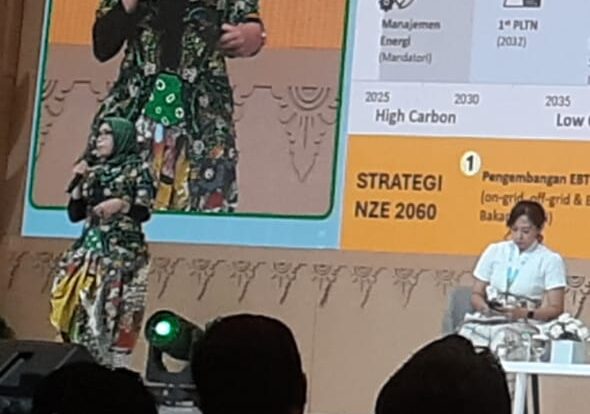
“There is indeed an offer from Norway. For floating solar, it is being discussed with the Environment Ministry, whether they can buy it at US$20–40 per ton of CO₂,” Eniya said in her presentation at the IndoEBTKE ConEx 2026 in Jakarta on Wednesday.
However, Eniya said the government needs to further assess the proposed scheme, as selling carbon credits at an early stage could potentially limit the economic benefits that Indonesia could obtain in the future.
“It is an opportunity, but I am still discussing it because it is somewhat like selling in advance,” she said.
The offer comes as the government is accelerating the development of solar power in Indonesia, with a target of around 100 gigawatt peak (GWp). The government is also developing a framework for carbon development and utilization from solar power projects.
According to Eniya, the government is currently adjusting its electricity planning, including revising the Electricity Supply Business Plan (RUPTL), following the inclusion of the 100 GWp solar target and changes in assumptions regarding the energy mix.
“Once we include 100 GWp, the 17 GW will be shifted,” she said.
Previously, solar power development under the RUPTL stood at around 17 GW. With the new 100 GWp target, the government needs to adjust its overall power generation planning and requirements for other energy sources.
The latest planning also includes 500 MW of nuclear power capacity. At the same time, the government plans to reduce the use of natural gas for power generation, with some gas supplies being redirected to industrial users.
“Gas does not all have to be used for power generation. The Minister of ESDM’s direction is to shift its use toward industry,” Eniya said.
With these changes, the government intends to maintain geothermal power as part of the baseload generation mix, while hydropower capacity is expected to increase. The government is also seeking to revive investment in wind power.
Eniya highlighted the lack of significant new investment in wind power projects following the Sidrap and Jeneponto wind farms. She said the situation requires attention, particularly as wind power has already been included in the RUPTL.
“There has been no investment in wind power since Sidrap and Jeneponto. That has been more than five years. We need to pay attention to this together,” she said.
US$4 Carbon Price Too Low
Eniya also criticized the US$4 per ton CO₂ carbon price assumption used in calculating the economic benefits of the 100 GWp solar program, saying the figure is too low. She said the government had previously estimated that the program could generate potential savings of up to Rp73.9 trillion, create around 5.5 million jobs and reduce emissions by approximately 140 million tons of CO₂.
However, Eniya said the economic value of carbon based on the US$4 per ton assumption does not reflect the potential value of carbon in international markets.
“This is too cheap. This is what we are now discussing—negotiating internationally to see whether we can get a higher price,” she said.
She noted that carbon prices in several international markets, including Europe, could reach around US$100 per ton of CO₂. Therefore, the government needs to encourage more competitive pricing for carbon credits generated by Indonesia’s renewable energy projects. “It is very different. We are working so hard to develop renewable energy, but its carbon is valued at only US$4 per ton. We need to push for a higher price,” Eniya said.
Against this backdrop, Norway’s US$20–40 per ton offer could provide a new price reference for carbon credits generated by Indonesia’s renewable energy sector.
The government, Eniya said, is currently calculating a carbon development framework covering various types of solar power projects, including ground-mounted solar, rooftop solar and floating solar.
Ground-mounted solar development would not be limited to dedicated power plant sites but could also utilize other areas, including land along railway corridors.
Meanwhile, rooftop solar deployment has continued to grow following the issuance of regulations governing rooftop solar development. For floating solar, Indonesia already has experience through the 192–193 MW Cirata Floating Solar Power Plant, which has become a reference project for large-scale floating solar development. “We are currently calculating the concept for all types of solar power,” Eniya said.
She added that the government is also finalizing several policies to accelerate the 100 GWp solar development program, including a draft presidential regulation (Perpres). Inputs from industry players and other stakeholders, she said, would be taken into consideration in developing the policy framework. “We are taking into account and calculating the inputs from our colleagues,” Eniya said. ***