
Ecobiz.asia – Indonesia’s Katingan Mentaya Project, one of the world’s largest peatland conservation initiatives, has returned to the international voluntary carbon market with the issuance of approximately 20 million verified carbon credits, following the reopening of Indonesia’s international carbon market and the completion of a major scientific review required under Verra’s carbon standard.
The project received verification for around 20 million tonnes of CO₂ equivalent emission reductions, or 17.3 million Verified Carbon Units (VCUs) after buffer deductions.
The credits, covering the 2021–2023 monitoring period, have received AA ratings from both BeZero Carbon and Sylvera, and are certified under Verra’s Verified Carbon Standard (VCS) and Climate, Community & Biodiversity Standards (CCBS).
The issuance marks the project’s return to issuance following a period in which PT. Rimba Makmur Utama and Permian Global, the companies that manage the initiative, undertook a comprehensive review of the project’s baseline assumptions.
Consistent with the methodology, this work happened 10 years after the project started and involved rigorous testing of the original calculations and assumptions against the latest scientific knowledge and regulations
“This credit issuance is a milestone for us,” said Dharsono Hartono, Chief Executive Director of PT Rimba Makmur Utama in a statement Tuesday (July 7, 2026).
He said the updated baseline ensured the project’s climate assumptions remain scientifically robust while enabling the project to generate revenue needed to maintain conservation activities and community programmes.
The issuance also reflects the reopening of Indonesia’s international carbon market following the government’s regulatory reforms and the mutual recognition agreement signed between Indonesia and Verra in October 2025, which allows internationally verified forestry carbon credits to be issued under Indonesia’s updated carbon market framework.
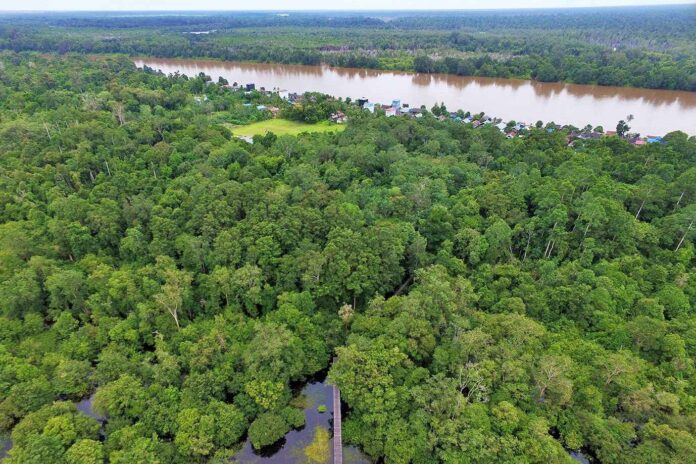
Established in 2010, the Katingan Mentaya Project protects and restores 157,875 hectares of tropical peat swamp forest in Central Kalimantan that was previously designated for industrial acacia plantation development. The project is home to endangered wildlife including the Bornean orangutan, helmeted hornbill, and Sunda pangolin, while supporting sustainable livelihoods in 41 local villages.
“This is an important milestone for us and, we believe, for the broader carbon market too,” said Urvesh Kotecha, Chief Commercial Officer at Permian Global. ***