
Ecobiz.asia — Indonesia will issue more than 30 million tonnes of forestry carbon credits on July 6, 2026, marking the country’s largest-ever issuance of forestry-based emission reductions and signaling its readiness to enter a new phase of implementing a credible and high-integrity carbon market.
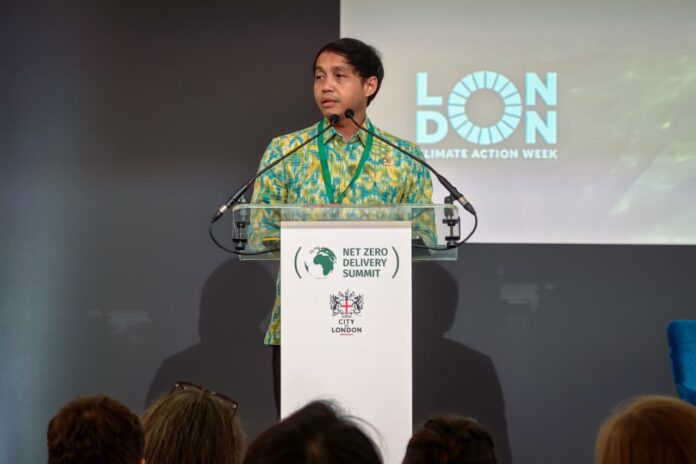
The announcement was made by Forestry Minister Raja Juli Antoni during the high-level session “From Fragile to Financeable – De-risking Carbon Credit Markets” at London Climate Action Week 2026 in London on Wednesday (June 24, 2026).
According to Raja Juli, Indonesia has moved beyond the policy-design stage and is now focused on implementing a robust carbon market framework supported by strengthened governance and market infrastructure.
“This demonstrates that Indonesia is not only building policy frameworks but also creating concrete and credible market opportunities for investors,” Raja Juli said.
He noted that Indonesia’s carbon market architecture has been strengthened through Presidential Regulation No. 110 of 2025 on Carbon Economic Value, which provides the foundation for a more integrated and credible national carbon market.
In the forestry sector, the regulation is supported by Forestry Ministerial Regulations No. 6 and No. 7 of 2026, which govern carbon trading procedures, environmental integrity standards, transparency requirements, and investment certainty for forestry carbon projects.
Beyond the carbon credit issuance, Indonesia is also set to launch its Carbon Unit Registry System (SRUK) on July 9, 2026. The platform is expected to become the backbone of the country’s carbon market governance by improving transparency, accountability, traceability, and regulatory certainty for project developers, businesses, and investors.
The SRUK launch will be accompanied by the registration of several forestry carbon projects using internationally recognized standards.
Addressing an audience of government officials, financial institutions, international organizations, businesses, and carbon market developers, Raja Juli said Indonesia is ready to offer a broad range of nature-based investment opportunities, including projects involving tropical forests, peatlands, and mangrove ecosystems.
The government is also exploring complementary climate technologies such as biochar and Carbon Capture, Utilization and Storage (CCUS) to expand its portfolio of carbon mitigation solutions.
During the forum, Raja Juli called on the international community to take three collective actions to strengthen global carbon markets. First, he urged stakeholders to send a strong market signal supporting high-integrity carbon credits. Second, he encouraged corporations and financial institutions to incorporate quality carbon credits into their climate transition strategies. Third, he called for stronger international cooperation under Article 6 of the Paris Agreement.
According to Raja Juli, equitable international partnerships that respect national priorities will be essential to building a larger and more trusted global carbon market.
“Indonesia stands ready to work with global partners to build a strong, credible, and effective carbon market ecosystem that supports the achievement of global climate goals,” he said. ***