
Ecobiz.asia — The Indonesian government, through the Ministry of National Development Planning (Bappenas) and the Environmental Fund Management Agency (BPDLH), has partnered with the United Kingdom government through the Foreign, Commonwealth and Development Office (FCDO) to fund four low-carbon innovation projects under the Low Carbon Development Initiative–Innovation and Technology Fund (LCDI-ITF).
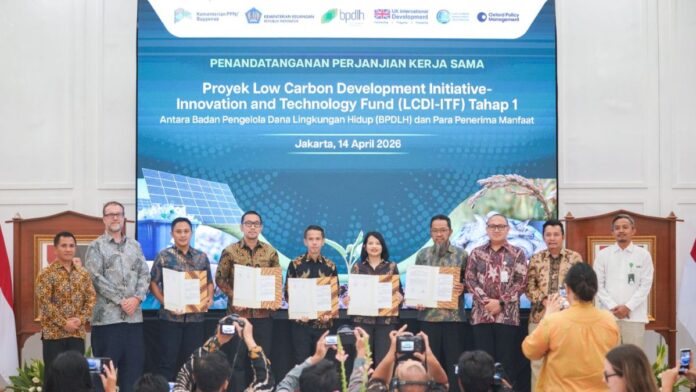
The cooperation agreement with the four selected beneficiaries was signed at the Bappenas building in Jakarta on Tuesday (April 14, 2026), marking the start of funding implementation for technology-based low-carbon projects across several regions in Indonesia.
Deputy for Food, Natural Resources, and Environment at Bappenas Leonardo A.A. Teguh Sambodo said the Innovation and Technology Fund serves as a key instrument to implement the government’s low-carbon development policy.
“This is not merely ceremonial, but the culmination of a collective effort. The Innovation and Technology Fund demonstrates how policies and planning can be translated into tangible impact,” he said.
The LCDI-ITF program aims to identify and scale up technological solutions that can reduce greenhouse gas emissions while supporting inclusive economic growth. It also aligns with national priorities, including the circular economy, blue economy, spice downstreaming, and regenerative agriculture.
Out of 283 proposals with a total funding request of Rp1.59 trillion, the government has selected four initial projects with a combined funding allocation of Rp20.33 billion. These projects cover waste management, solar-powered shrimp farming, sustainable spice processing, and rice agriculture decarbonization.
BPDLH President Director Joko Tri Haryanto highlighted the importance of implementation in advancing low-carbon innovation.
“Through this scheme, we aim to help innovations cross the ‘valley of death’ so they can scale up and deliver real impact,” he said.
UK Embassy Minister Counsellor (Development) Peter Rajadiston said climate solutions must deliver direct benefits to communities.
“Effective climate solutions should improve livelihoods, create green jobs, and strengthen community resilience,” he said.
As of 2024, Indonesia has recorded a potential emissions reduction of 30.36% through more than 29,000 cross-sectoral actions. ***