
Ecobiz.asia – Indonesia’s Ministry of Marine Affairs and Fisheries (KKP) is drafting regulations to establish a carbon market framework for the marine and fisheries sector, covering blue carbon projects, carbon offset trading, results-based payments, and mandatory benefit-sharing with local communities.
The proposed regulation, obtained by Ecobiz.asia, would implement Presidential Regulation No. 110 of 2025 on Carbon Economic Value Instruments and National Greenhouse Gas Emissions Control.
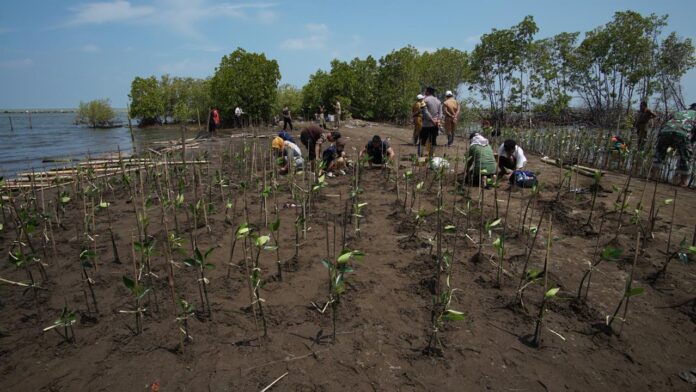
The draft would serve as the legal foundation for carbon trading activities across Indonesia’s marine and fisheries sector, including blue carbon ecosystems such as mangroves, seagrass meadows, and coastal habitats.
Its scope extends beyond blue carbon to include fisheries, fish transportation, fishing ports, aquaculture, seafood processing, and fisheries marketing, with each subsector expected to implement climate mitigation measures through energy efficiency, emissions reductions, ecosystem restoration, and carbon sequestration.
One of the regulation’s key provisions establishes procedures for greenhouse gas emission offset trading in both domestic and international carbon markets.
All projects would be required to complete registration, validation, verification, and recording through Indonesia’s Carbon Unit Registry System (SRUK) before carbon credits can be issued.
Projects seeking to transfer carbon credits internationally under Article 6 of the Paris Agreement would also be required to obtain government authorization and apply corresponding adjustments in accordance with Presidential Regulation No. 110 of 2025.
The draft places particular emphasis on benefit-sharing with local communities participating in blue carbon projects.
Project developers would be required to prepare a benefit-sharing plan under which communities receive at least 50% of net financial benefits, distributed progressively and/or proportionally, unless a project adopts a more generous arrangement.
In addition to financial returns, projects must also provide non-monetary benefits, including capacity building, technology transfer, improved access to resources, and alternative livelihood opportunities.
The regulation also introduces environmental and social safeguard requirements.
Developers would be required to obtain Free, Prior and Informed Consent (FPIC) from affected communities, conduct environmental and social impact assessments, protect biodiversity, and prevent overlapping project boundaries through coordinate-based verification within the SRUK system.
Carbon projects must also be consistent with Indonesia’s coastal spatial planning and marine zoning plans.
The proposed regulation reflects Indonesia’s broader effort to expand implementation of Presidential Regulation No. 110 of 2025 across multiple sectors.
The Ministry of Agriculture is currently preparing similar regulations for agricultural carbon trading, while the Ministry of Energy and Mineral Resources is drafting rules for the energy sector.
To date, the Ministry of Forestry remains the first ministry to issue an operational carbon trading regulation, having enacted Ministerial Regulation No. 6 of 2026 governing greenhouse gas emission offset trading in the forestry sector. ***