
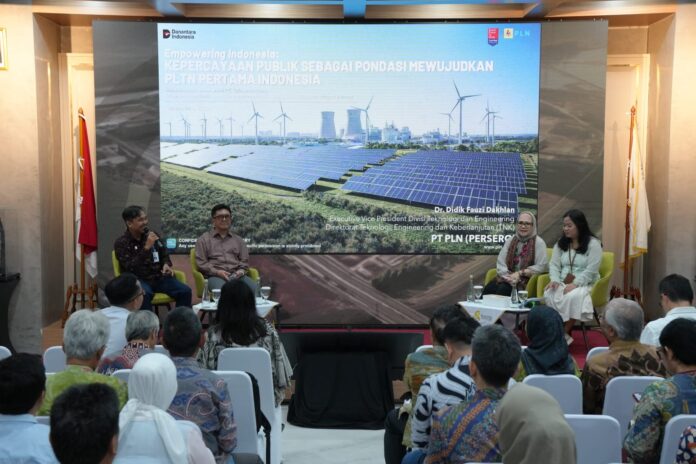
Ecobiz.asia – Indonesia’s plan to bring its first nuclear power plant online by 2032 is facing a fundamental challenge that goes beyond technology or financing. Public trust is emerging as the key issue.
A discussion hosted by the Purnomo Yusgiantoro Center (PYC) in Jakarta on April 28, 2026, highlighted that while regulatory frameworks, funding pathways, and technological readiness are largely in place, social acceptance remains a critical gap.
Indonesia has outlined a target of 500 megawatts (MW) of nuclear capacity, equivalent to two 250 MW units, within the 2025–2034 Electricity Supply Business Plan (RUPTL). The timeline is considered highly ambitious, given that large-scale nuclear projects globally typically take between seven and 12 years to complete.
Senior Researcher at the National Research and Innovation Agency (BRIN), Djarot Sulistio Wisnubroto, said the main hurdle lies in building public confidence.
“The road to Indonesia’s first nuclear power plant is not just a technical one. It is a journey to build public trust. Transparency is not a weakness. It is the strongest guarantee we can offer to the public,” he said.
This view was echoed by Netty Herawati of Tanjungpura University, who has studied public perceptions of nuclear energy for more than a decade.
“Technology is ready, regulations exist, and funding is being arranged, but social readiness has not been secured. Without it, the rest does not hold,” she said.
An assessment by the International Atomic Energy Agency through its Integrated Nuclear Infrastructure Review (INIR) found that Indonesia has met 16 out of 19 readiness criteria. The remaining gaps include national positioning, institutional structure, and stakeholder engagement, particularly public acceptance.
Didik Fauzi Dakhlan, Executive Vice President at Perusahaan Listrik Negara (PLN), said stakeholder engagement remains the weakest area. “Public acceptance is still in the red zone,” he noted.
Experts describe public acceptance using a four-level framework: legitimacy, acceptance, approval, and psychological identification. Indonesia is currently assessed to be between the first and second levels, meaning most communities acknowledge nuclear power but have yet to actively support it.
The challenge is compounded by the Not-In-My-Backyard phenomenon, where local communities resist projects despite recognizing broader national benefits. Similar patterns have derailed nuclear projects in multiple countries, often due to poor engagement rather than technical issues.
In Indonesia, a notable case is West Kalimantan, where surveys show support for nuclear energy reaching nearly 90 percent. However, researchers found that this support is driven more by dissatisfaction with electricity imports than by a clear understanding of nuclear technology.
Communities tend to focus on practical concerns, particularly the direct benefits they would receive if a plant is built in their area. Researchers say these questions have not been sufficiently addressed in past public outreach efforts.
Netty noted that traditional top-down “sosialisasi” approaches are increasingly ineffective.
“Communities are tired of one-way communication. They want to be heard, to ask questions, and to challenge decisions,” she said, based on field research.
Indonesia’s previous attempt to develop a nuclear power plant in Muria, Central Java, also underscores the importance of public engagement. The project, initially planned decades ago, was halted following public protests and opposition from local religious leaders.
Experiences from other countries reinforce this lesson. Following the Fukushima nuclear disaster, public trust in nuclear energy in Japan dropped sharply and has only gradually recovered through sustained, community-level engagement.
With a 2032 target, Indonesia has limited time to close the trust gap. Analysts estimate that building a strong social license to operate for nuclear projects typically takes decades.
Beyond the initial 500 MW target, Indonesia’s long-term energy roadmap projects nuclear capacity reaching 35 gigawatts (GW) by 2060, requiring large-scale project development to begin in the near term.
PLN has indicated that both small modular reactors and large-scale plants will be needed to meet future demand. The Muria Peninsula remains one of the most technically advanced candidate sites, with existing studies and infrastructure supporting its feasibility.
Experts at the forum emphasized that technical preparation and trust-building must proceed simultaneously.
“Technology can be transferred,” Netty said. “But trust must be built. Nuclear energy is not just an engineering issue. It is about relationships with communities, society, and the future of Indonesia’s energy system.” ***