
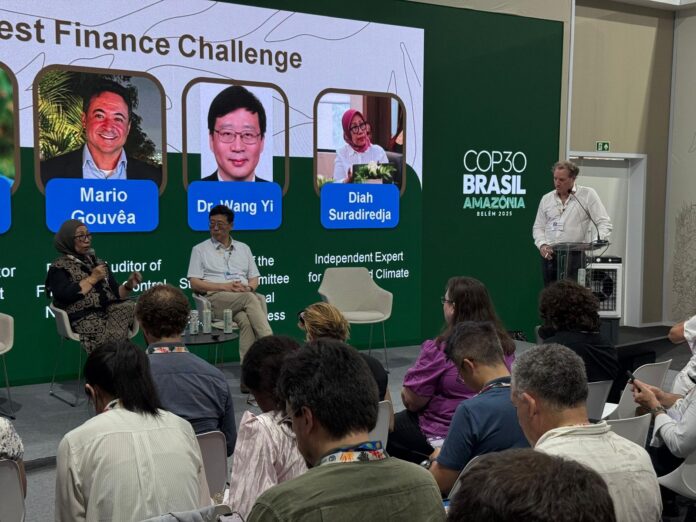
Ecobiz.asia — Global collaboration is essential to closing the financing gap for sustainable forest management and ensuring that deforestation-free commodity supply chains remain fair and inclusive, sustainability and climate expert Diah Suradiredja said at a COP30 Belém side event on Friday (Nov. 14, 2025).
Speaking at the Tropical Forest Alliance (TFA) session titled “Closing the Forest Finance Gap: Investing in People, Planet & Progress”, Diah said Indonesia’s recent experience shows that environmental governance and trade can reinforce each other in building responsible global supply chains.
The panel also featured Brazil’s National Treasury official Mário Gouvêa and Wang Yi of the Chinese Academy of Science.
“The question is always the same, can trade and environmental governance work together? The answer is yes. And Indonesia proves it,” she said.
Diah noted that Indonesia has strengthened national sustainability systems over the past three years, including ISPO, SVLK, and the National Dashboard for Legal and Risk Verification, which align with the risk-based due diligence requirements under the EU Deforestation Regulation (EUDR). These systems enhance legality, traceability, and geolocation-based verification across palm oil, timber, and other commodity supply chains.
However, she warned that regulatory mechanisms alone are insufficient. “Trade must be translated into shared responsibility. Data-driven collaboration has helped reduce misperceptions between producing and consuming countries,” she said.
Diah stressed the need to connect trade and finance, arguing that forest-positive value chains cannot grow without adequate support for smallholders. Indonesia, she said, is promoting sustainability-linked finance, jurisdictional certification, and blended finance mechanisms to expand access for smallholders, women, and local cooperatives.
“A just transition is not about shifting risks onto producers. Risk must be shared, not transferred,” she said.
She also underscored the importance of ensuring that financing reaches the ground, noting that deforestation-free supply chains depend on real support for farmers, Indigenous peoples and local communities.
Diah highlighted the growing role of South–South cooperation, with Indonesia, Brazil, Congo Basin countries and China increasingly shaping global norms for sustainable trade.
“Producing countries should not only follow standards, they must shape them. This is the moment for Southern landscapes to define the future of global sustainability,” she said.
She concluded by emphasizing that success should be measured by real outcomes: “Success is not about documents or administrative compliance. It is about how many forests remain standing, how many livelihoods improve, and how much trust grows between those who grow and those who buy.” ***