
Ecobiz.asia – Indonesia called on global investors to accelerate collaboration in developing carbon capture and storage (CCS) and carbon capture, utilization, and storage (CCUS) projects in the country’s upstream oil and gas sector, in line with ASEAN’s efforts to strengthen its position in the global low-carbon energy transition.
The initiative was presented by Indonesia’s Upstream Oil and Gas Regulatory Task Force (SKK Migas) and partners during the Abu Dhabi International Petroleum Exhibition and Conference (ADIPEC) 2025 in the United Arab Emirates.
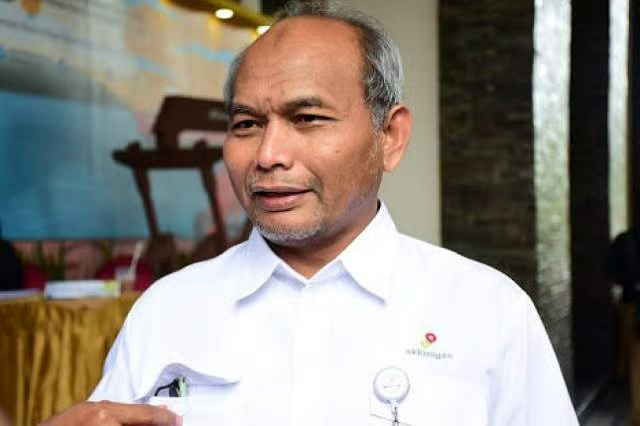
SKK Migas Chief Djoko Siswanto said Indonesia is open to CCS and CCUS investment through various strategic partnership schemes. “Developing CCS and CCUS projects is part of Indonesia’s commitment to a sustainable energy sector, while highlighting ASEAN’s growing role in the global energy transition,” he said on the sidelines of the ADIPEC 2025 forum, Thursday (Nov 6, 2025).
Indonesia has included several CCS/CCUS developments in its list of National Strategic Projects (PSN), including the bp Tangguh UCC project, which is expected to start operations in the third quarter of 2028. The project has a planned storage capacity of up to 1.8 gigatons of CO₂, with peak production reaching 476 MMSCFD—equivalent to 56 LNG cargoes and 4,700 barrels of condensate per day.
The country is currently developing 19 CCS and CCUS projects scheduled to begin operations within the next five years. These projects are spread across various upstream working areas, including Aceh, which is being prepared as an open CCS/CCUS hub under the Aceh Oil and Gas Management Agency (BPMA). Since 2019, a series of studies have been carried out, including geological evaluations, carbon dioxide transport and storage schemes, and carbon monetization models.
“Beyond emission reduction, the CCS/CCUS initiative in Aceh opens up broader partnerships, from technology transfer and geological research to the development of a carbon management ecosystem that benefits local communities,” said BPMA G&G Technical Lead Brianto Adhie Wardhana during his presentation at the Indonesia Pavilion.
Supportive policy frameworks have also become a key driver for CCS/CCUS development in Indonesia. According to the ASEAN Centre for Energy (ACE), Indonesia has the most comprehensive legal and regulatory framework for CCS/CCUS in Southeast Asia.
Key policies include Presidential Regulation No. 14/2024, which enables carbon monetization and tax incentives; Energy and Mineral Resources Ministerial Regulation No. 20/2023, recognizing CCS/CCUS in upstream oil and gas as part of operational costs; and Regulation No. 16/2024, which governs carbon storage licensing areas.
During the four-day ADIPEC event, the Indonesia Pavilion showcased the theme “Potentials to Discover, Partners to Deliver,” highlighting the country’s partnership opportunities in oil and gas, low-carbon energy, and a more competitive regulatory environment. The exhibition served as a strategic platform to attract global partners and advance the vision of a sustainable energy future. ***