
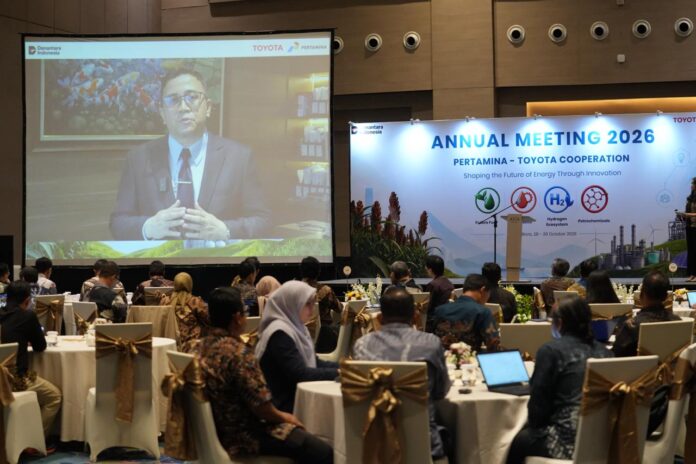
Ecobiz.asia – Indonesia’s state-owned energy company Pertamina and Japan’s Toyota Group have extended their strategic partnership for another five years through 2030, with cooperation covering low-carbon fuels, lubricants, hydrogen technology and petrochemical products.
The extended partnership was discussed at the 2026 Pertamina–Toyota Cooperation Annual Meeting in Surakarta, Central Java, as the two companies seek to align fuel development with advances in automotive technology and support Indonesia’s energy security and transition.
Pertamina Deputy President Director Oki Muraza said the partnership supported Indonesia’s national priorities, particularly the Asta Cita agenda to strengthen energy security and accelerate the energy transition through innovation.
He said geopolitical developments and changes in global energy markets had made strategic cooperation increasingly important.
“The achievements demonstrate the progress of our collaboration and reflect our shared commitment to translating technical expertise and innovation into tangible business results,” Oki said in a statement cited on Tuesday (Nov. 3,2026).
Pertamina Senior Vice President for Technology Innovation and Implementation Hana Timoti said the partnership was based on the complementary expertise of the two companies. Pertamina focuses on developing and supplying fuels, while Toyota contributes automotive technology and an understanding of the energy requirements of the transport sector.
She said the companies needed to ensure that fuel development kept pace with changes in vehicle technology, so that Pertamina’s products could meet the needs of future vehicles and the automotive industry.
The cooperation also covers alternative energy sources, although Hana said wider adoption would depend on the development of supporting infrastructure and commercially viable business models.
“One of the challenges in developing alternative energy is building an ecosystem that allows the technology to be widely used and economically viable,” she said.
Hydrogen-powered vehicles, for example, were already being developed, but commercial deployment would require reliable fuel supplies, infrastructure and viable business models. Cost competitiveness also remained a challenge, as fossil fuels were still relatively cheaper, she added.
Hana said energy choices should not be assessed solely on price, but also on supply availability and the ability to meet domestic demand. Developing energy sources that could be produced within Indonesia was therefore important to strengthening national energy security.
“For energy security, we will focus on resources that are available in Indonesia and can be produced domestically. They may still be more expensive, but availability is also a consideration when comparing an expensive source that is available with a cheaper one that is not,” she said.
Keiji Kaita, president of Toyota Motor Corporation’s CN Advanced Engineering Development Center, said carbon-neutral fuels could contribute not only to emissions reduction but also to energy security.
He said Indonesia had significant potential to produce its own fuels, creating opportunities for further research and technology development.
Kaita said the partnership could become an important milestone in cooperation between the two companies, supporting carbon neutrality, fuel supply security, technological transformation and improvements in public welfare.
“I believe this meeting can become an important milestone in our collaboration and contribution to Indonesian society,” he said. ***