
Ecobiz.asia – Indonesia is considering a moratorium on new smelters producing semi-finished mineral products as the government seeks to push downstream processing further and capture more value from its mineral resources.
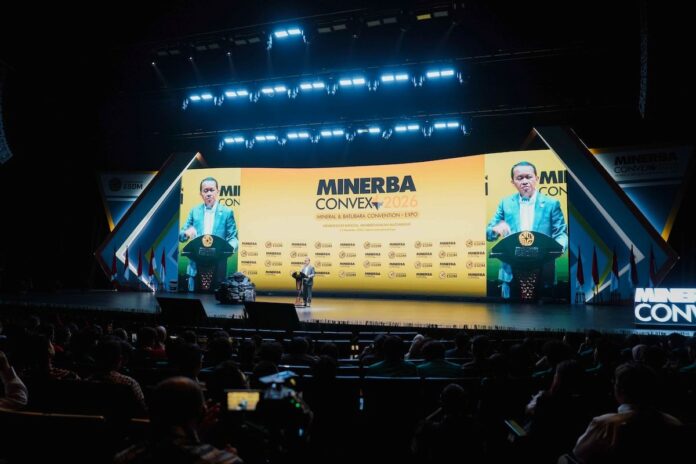
Speaking at Minerba Convex in Jakarta on Monday (Nov. 2, 2026), Energy and Mineral Resources Minister Bahlil Lahadalia said the government would assess whether further investment in facilities producing intermediate materials was still necessary, given the rapid expansion of the country’s mineral processing industry.
“We may need to study whether smelters producing only semi-finished products should still be allowed, or whether we should impose a moratorium and instead encourage the development of final products,” he said.
Indonesia’s downstream mineral industry remains largely focused on intermediate products, with processing levels reaching around 50% to 60%, Bahlil said. The government wants to ensure that more minerals are processed into higher-value products domestically rather than exported in semi-finished form.
He cited the nickel industry as an example of how domestic processing can increase export earnings. Indonesia’s nickel exports rose from US$3.3 billion in 2017–2019 to around US$34 billion in 2023–2024, following the government’s ban on raw nickel ore exports and the expansion of domestic processing facilities, he said.
Bahlil also pointed to the development of an integrated electric vehicle battery supply chain, spanning mining, smelting, high-pressure acid leaching (HPAL), precursor and cathode production, and battery cell manufacturing.
He said Indonesia now had three battery factories, including a facility in Weda Bay that was recently inaugurated by President Prabowo Subianto. The first factory, developed by South Korea’s LG Energy Solution and Hyundai, was inaugurated in Karawang in 2024. Another facility, developed by state-owned miner Aneka Tambang (Antam) and China’s CATL, was scheduled to be inaugurated by Prabowo in Karawang in November.
Bahlil said the development of the battery industry demonstrated the importance of consistent government policy in building domestic manufacturing capacity.
“ All of this has happened because of consistency,” he said.
Beyond nickel, Bahlil identified coal as another resource with potential for further domestic processing. Technological developments, he said, had made it possible to convert coal into gas and liquefied petroleum gas (LPG). Low-calorie coal could also be used to produce dimethyl ether (DME), which could serve as an alternative to LPG.
Bahlil did not specify when the government would complete its study or whether the proposed moratorium would apply to particular minerals, smelter types or semi-finished products. ***