
Ecobiz.asia – The Indonesian Environment Fund (IEF), or BPDLH, is expanding micro-scale financing for forest communities through a partnership with cocoa trader PT Jebe Trading Indonesia (JB Cocoa) and Rainforest Alliance.
The partnership aims to connect financing with production and market access, with JB Cocoa serving as an offtaker and Rainforest Alliance supporting sustainable farming practices and value-chain development.
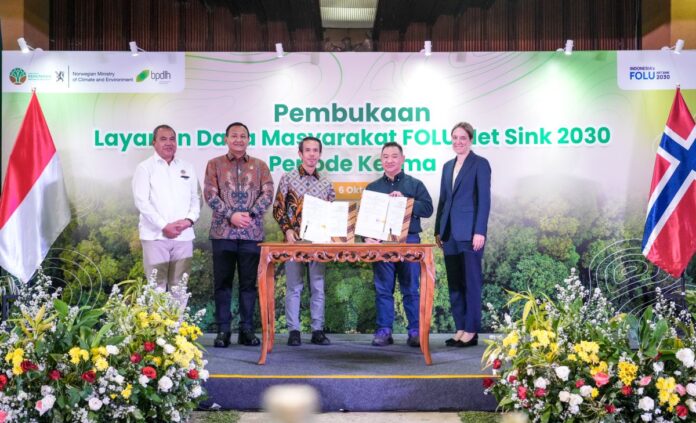
The cooperation was formalized through a memorandum of understanding (MoU) signed by BPDLH, JB Cocoa and Rainforest Alliance in Jakarta on Tuesday (Oct. 6, 2026), alongside the launch of the fifth phase of the FOLU Net Sink 2030 Small Grant Facility.
Under the scheme, BPDLH will provide financing through its Revolving Fund Facility (Fasilitas Dana Bergulir/FDB) to social forestry and agroforestry business groups. JB Cocoa will absorb their products as an offtaker, while Rainforest Alliance will support sustainable agricultural practices, capacity building and commodity value-chain development.
BPDLH President Director Joko Tri Haryanto said financing for communities around forests needs to be sustained to ensure businesses can continue operating beyond initial support.
He said the FDB was being developed with an approach similar to microfinance to support the long-term viability of community enterprises.
“This cooperation is not merely about signing a document, but about building a bridge from forests to markets—from communities that protect and manage forests to products that generate added value and can be accepted by the market,” Joko said.
Through the partnership, BPDLH aims not only to provide financing but also to ensure that products produced by community groups have access to markets. The approach is expected to increase product value, sustain production and strengthen the business viability of FDB recipients.
JB Cocoa will focus on absorbing community-produced commodities, while Rainforest Alliance will support farmers’ capacity building and the adoption of sustainable agricultural practices.
Joko said the approach was part of BPDLH’s effort to build an integrated business ecosystem connecting forest communities with markets.
“We are trying to create an integrated value chain. From farmers all the way to the market, we are building a closed-loop ecosystem,” he said.
The FDB initiative comes as Indonesia expands its FOLU Net Sink 2030 Small Grant Facility. In its fifth phase, the Ministry of Forestry, through BPDLH, has allocated Rp20 billion ($1.2 million) to support 300 community groups.
The Small Grant Facility is part of Indonesia’s forestry cooperation with Norway under the Result-Based Contribution (RBC) mechanism. Through its fourth phase, the program had disbursed around Rp29.081 billion to 863 community groups, reaching 49,653 beneficiaries across 36 provinces.
Unlike grants provided through the Small Grant Facility, the FDB is designed to provide longer-term financing for community businesses, particularly social forestry and agroforestry groups.
By combining financing, production support and market access, BPDLH aims to help community enterprises grow while creating economic incentives for forest and environmental protection. ***