
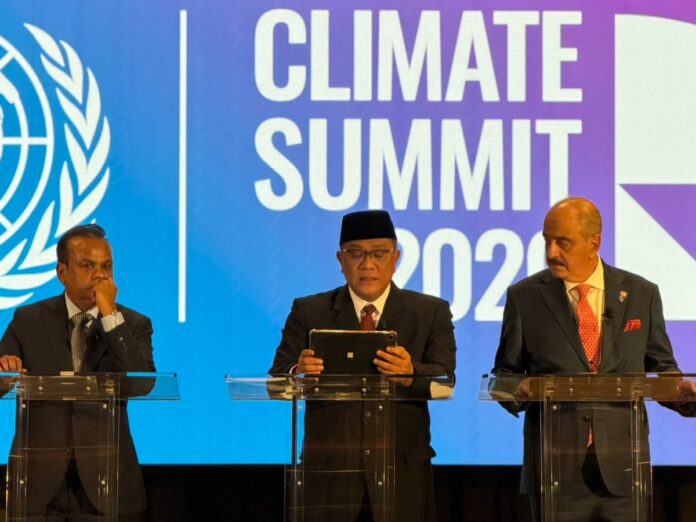
Ecobiz.asia – Indonesia has called for climate action that not only meets global targets but also strengthens economic resilience, creates green jobs and protects vulnerable communities, Environment Minister and Head of the Environmental Control Agency (KLH/BPLH) Moh Jumhur Hidayat said at a United Nations climate dialogue.
Jumhur delivered Indonesia’s position at the Interactive Leaders Dialogue on Climate Action and the Just Transition during the 81st session of the UN General Assembly in New York on Wednesday (Sept. 23, 2026). The UN said the high-level event focused on accelerating a just and orderly transition to renewable energy, scaling up affordable climate finance for developing countries, and strengthening adaptation and resilience.
Jumhur said the narrowing window to keep global warming below 1.5 degrees Celsius required countries to translate global commitments into concrete action based on fairness and the principle of common but differentiated responsibilities and respective capabilities.
“The Paris Agreement is our compass. However, as the space to keep global temperature rise to 1.5 degrees Celsius becomes increasingly narrow, our challenge is to bridge global commitments into tangible results, guided by justice and the principle of common but differentiated responsibilities and respective capabilities,” Jumhur said.
In the forestry sector, Indonesia is continuing its FOLU Net Sink 2030 agenda, aimed at ensuring greenhouse gas removals from terrestrial ecosystems exceed emissions released from the sector.
In the waste sector, the government is seeking to cut methane emissions through improved solid waste and wastewater management, circular economy initiatives and stronger local governance.
Indonesia is also pursuing industrial decarbonization through the transformation of existing industries and the development of low-carbon facilities, including carbon capture, utilization and storage (CCUS).
In the energy sector, the measures outlined by Jumhur include expanding renewable energy such as solar and geothermal power, implementing the mandatory B50 biodiesel program and developing an electric vehicle ecosystem to increase domestic value creation.
“Our transition must be just, orderly, state-led and people-centered. The energy transformation must strengthen energy security and affordability, create decent green jobs and local value, and protect vulnerable communities,” Jumhur said.
Adaptation and Climate Finance
Indonesia is also pursuing adaptation alongside mitigation. Jumhur said coastal infrastructure, including the Giant Sea Wall planned along Java’s northern coast, should be integrated with mangrove protection and restoration to safeguard coastal communities.
He said such a transformation requires fair access to international climate finance. International funding, he added, needs to be affordable and accessible across the full policy cycle, from risk mapping and technology deployment to strengthening local capacity.
Indonesia is also calling for stronger loss and damage mechanisms and progress toward the New Collective Quantified Goal on Climate Finance (NCQG) ahead of the UN climate conference, COP31, in Antalya, Türkiye. ***