
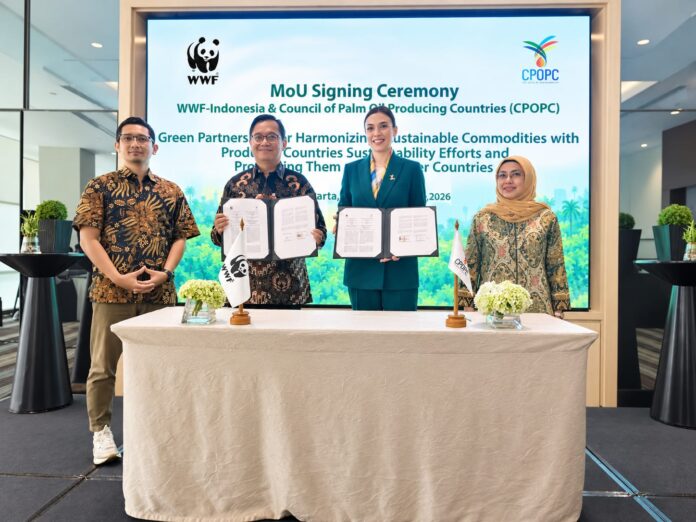
Ecobiz.asia – WWF-Indonesia and the Council of Palm Oil Producing Countries (CPOPC) signed a memorandum of understanding (MoU) on Friday (Sept. 18, 2026) in Jakarta to strengthen transparency and sustainability in commodity supply chains, with a focus on improving their recognition in global markets.
The partnership, dubbed the “Green Partnership,” will focus on supply chain transparency, sustainability certification, responsible production, biodiversity conservation and greater participation of independent smallholders in sustainable supply chains.
The agreement comes as palm oil producers face growing sustainability requirements in global markets, including the European Union Deforestation Regulation (EUDR), which requires companies to demonstrate that relevant commodities placed on the EU market are not linked to deforestation.
WWF-Indonesia CEO Aditya Bayunanda said greater collaboration among producing countries, businesses, certification bodies, civil society, independent smallholders and global markets is needed to strengthen the credibility of sustainable plantation commodities.
“Sustainable plantation commodities are not simply a supply chain issue, but an effort to protect Indonesia’s biodiversity,” Aditya said.
He said the partnership with CPOPC would help strengthen Indonesia’s Indonesian Sustainable Palm Oil (ISPO) certification and other national certification systems developed by producing countries so they can gain greater recognition in global markets.
“There is a gap between certified production capacity and acceptance in global markets,” Aditya said.
CPOPC Secretary General Izzana Salleh said palm oil-producing countries and industry stakeholders had made significant investments in improving sustainability practices, protecting human rights and supporting livelihoods across the supply chain.
National sustainability certification schemes, including Indonesia’s ISPO and Malaysia’s Malaysian Sustainable Palm Oil (MSPO), reflect producing countries’ commitment to sustainability, she said.
However, further progress is needed to ensure smallholders have the resources, capacity and opportunities to participate fully in sustainable supply chains, Izzana said.
“By combining our expertise, experience and networks, we can turn our shared commitments into meaningful and inclusive action,” she said.
The MoU was followed by a webinar jointly organized by WWF-Indonesia, CPOPC and Competere titled Leave No Smallholder Behind: Making EUDR Compliance an Opportunity for Inclusive Development.
The discussion examined the implications of the EUDR for independent oil palm smallholders, particularly challenges involving geolocation, traceability and documentation. These requirements could pose significant structural challenges for smallholders seeking to maintain access to global supply chains.
The partnership will also support efforts to develop deforestation-free and legally compliant commodity supply chains, promote biodiversity conservation and strengthen traceability systems, including through the Hamurni application.
WWF-Indonesia said the collaboration also supports Indonesia’s broader climate and environmental targets, including its Second Nationally Determined Contribution (NDC), which targets a 31.89% reduction in greenhouse gas emissions by 2030 through domestic efforts and up to 43.20% with international support.
CPOPC and WWF-Indonesia said the partnership aims to ensure that smallholders are not left behind as the palm oil sector transitions toward more sustainable supply chains and seeks greater acceptance in global markets.
CPOPC was established by Indonesia and Malaysia in 2015. Its current members are Indonesia, Malaysia, Honduras, Papua New Guinea and the Democratic Republic of Congo, while Nigeria, Colombia, Ghana and Costa Rica are observer countries. Together, CPOPC members and observers account for 89.3% of global palm oil production, according to the organization. *** Jadita Banjar Nahor