
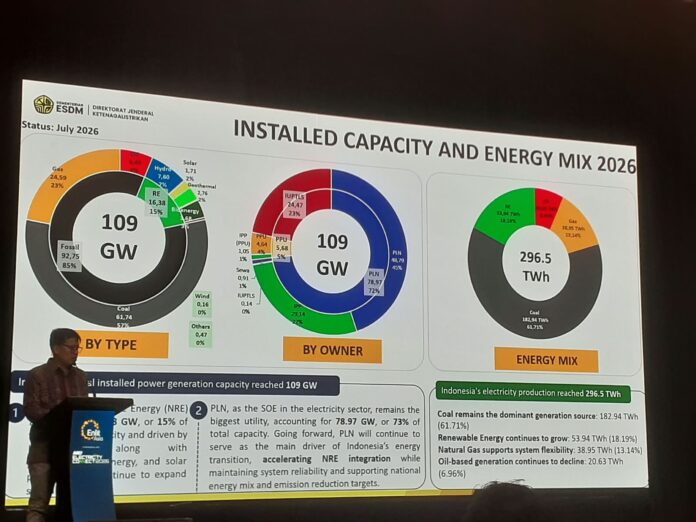
Ecobiz.asia – New and renewable energy (NRE) sources accounted for 18.19% of Indonesia’s total electricity generation in 2026, as the government continues to expand renewable energy integration into the national power system.
Ahmad Amiruddin, Director of Electricity Program Development at the Ministry of Energy and Mineral Resources (ESDM), said Indonesia generated 296.5 terawatt-hours (TWh) of electricity in 2026, with NRE-based power plants contributing 53.94 TWh.
“NRE continues to grow,” Ahmad said in his keynote speech at Electricity Connect 2026 in Tangerang on Tuesday (Sept. 22, 2026).
Coal remained the dominant source of electricity generation, producing 182.94 TWh, or 61.71% of total generation. Natural gas contributed 38.95 TWh, or 13.14%, while oil-fired generation accounted for 20.63 TWh, or 6.96%.
Ahmad said the contribution of NRE is expected to continue increasing as Indonesia restructures its electricity supply toward a lower-carbon generation mix.
As of July 2026, Indonesia’s total installed power generation capacity had reached around 109 gigawatts (GW), with state-owned utility PT PLN (Persero) accounting for 78.97 GW, or about 73% of the total.
PLN will continue to play a key role in accelerating NRE integration while maintaining system reliability and supporting Indonesia’s energy mix and emissions-reduction targets, Ahmad said.
NRE Targeted to Reach 74% by 2060
The government expects the share of NRE in electricity supply to increase substantially over the coming decades. Ahmad said NRE is projected to account for around 74% of Indonesia’s electricity supply by 2060.
The target is intended to support the National Energy Policy (KEN) target of a 70% NRE share of primary energy supply.
Under the General National Electricity Plan (RUKN), renewable sources such as solar, wind, hydropower, bioenergy and geothermal are expected to play a growing role in Indonesia’s future electricity generation mix.
The transition will also include new energy sources, particularly green hydrogen and green ammonia. Several coal-fired power plants are planned to gradually switch to ammonia starting in 2045, while gas-fired power generation is expected to be replaced by green hydrogen.
The government is also factoring electricity demand from industrial estates, special economic zones, smelters, integrated marine and fisheries centers, and priority tourism destinations into its projections.
Ahmad said the demand projections are designed to support Indonesia’s target of achieving 8% economic growth by 2029 while ensuring the electricity system can accommodate the country’s energy transition. ***