
Ecobiz.asia – Indonesia has launched a 2026–2045 roadmap for protecting and managing its blue carbon ecosystems, with French development agency Agence Française de Développement (AFD) supporting efforts to strengthen the policy, data and financing foundations needed to protect coastal ecosystems and attract investment.
The roadmap, launched by the Ministry of National Development Planning (Bappenas), is intended to integrate the management of coastal and marine ecosystems into Indonesia’s national climate and development policies.
Bappenas Minister Rachmat Pambudy said the roadmap marks a shift in Indonesia’s climate strategy from a primarily land-based approach toward an integrated strategy covering both terrestrial and marine ecosystems.
Its implementation will focus on four areas: cross-sectoral policy integration, innovative and sustainable financing, stronger data and monitoring, reporting and verification (MRV) systems, and inclusive benefit-sharing.
“With the launch of this roadmap, Indonesia is officially transforming its climate strategy from a land-based approach toward a more holistic integrated land-sea strategy,” Rachmat said at the launch in Jakarta on Monday (Sept. 21, 2026).
Bappenas Deputy for Food, Natural Resources and Environment Leonardo A.A. Teguh Sambodo said Indonesia has significant blue carbon resources but still faces gaps in their management.
These include the need to strengthen policies and regulations, improve cross-sectoral coordination, expand data and MRV systems, develop sustainable financing and build stakeholder capacity.
“We hope this roadmap can serve as a common foundation for creating protected and optimally managed blue carbon ecosystems that provide benefits for the environment, climate and the welfare of coastal communities toward Indonesia Emas 2045,” Leonardo said.
Indonesia’s Blue Carbon Potential
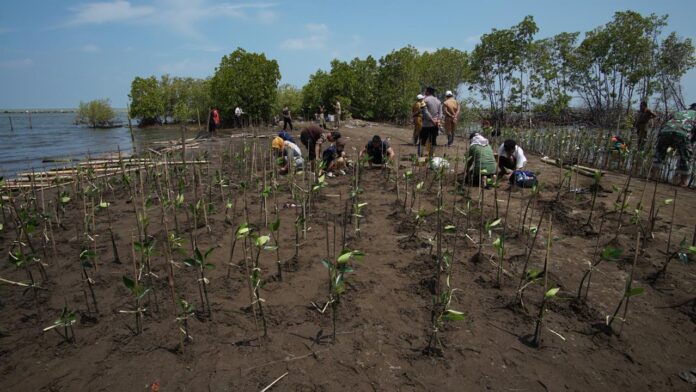
Bappenas identified three major blue carbon ecosystems in Indonesia: mangroves, seagrass meadows and tidal salt marshes.
Indonesia’s mangrove ecosystems are estimated to cover about 3.44 million hectares, or around 23% of the world’s mangrove area, with average carbon stocks of about 1,000 tons of carbon per hectare.
About 62% of Indonesia’s mangroves are considered to be in good condition, while the remaining 38% are degraded. Mangrove loss is estimated at around 19,500 hectares annually.
Seagrass meadows cover an estimated 655,000 hectares, with carbon stocks of 50–150 tons of carbon per hectare. Around 70% are considered to be in good condition, while 30% are degraded.
Detailed data on tidal salt marshes remains limited, although their potential area is estimated at 8.9 million hectares across coastal areas of Sumatra, Kalimantan, Sulawesi and Papua.
Deputy Minister of Environment and Deputy Head of the Environmental Control Agency Diaz Hendropriyono said national climate policy needs to expand its focus beyond terrestrial ecosystems.
“National climate policy cannot stop at land. It must also pay attention to the marine and coastal sectors,” Diaz said.
The roadmap also places coastal and Indigenous communities at the center of blue carbon ecosystem management through the application of Free, Prior and Informed Consent (FPIC) and Gender Equality, Disability and Social Inclusion (GEDSI) principles.
AFD Support
The roadmap was developed as part of cooperation between Bappenas and AFD through the Support for the Integration of Blue Carbon Ecosystems in Indonesia’s Biodiversity and Climate Policies project.
Since 2022, AFD has supported the development of Indonesia’s institutional and technical foundations for blue carbon, including the establishment of the Blue Carbon Secretariat at Bappenas, capacity building for carbon inventories and monitoring methodologies, as well as the development of data and guidelines.
AFD Deputy Country Director Caroline Edant said Indonesia has a strategic position in blue carbon management because of the scale of its coastal ecosystems.
“Indonesia’s position in blue carbon is also very important. Indonesia has the world’s largest mangrove ecosystem and 70% of the world’s blue carbon stocks,” Caroline said.
She said blue carbon ecosystems not only contribute to climate change mitigation and adaptation but also support fisheries and coastal livelihoods while protecting coastal areas from erosion and sea-level rise.
AFD will continue to support Indonesia in translating the roadmap into implementation, including by strengthening data and monitoring systems, developing innovative and sustainable financing mechanisms, and applying the strategy in mangrove and seagrass ecosystems in partnership with coastal communities. *** Jadita Banjar Nahor