
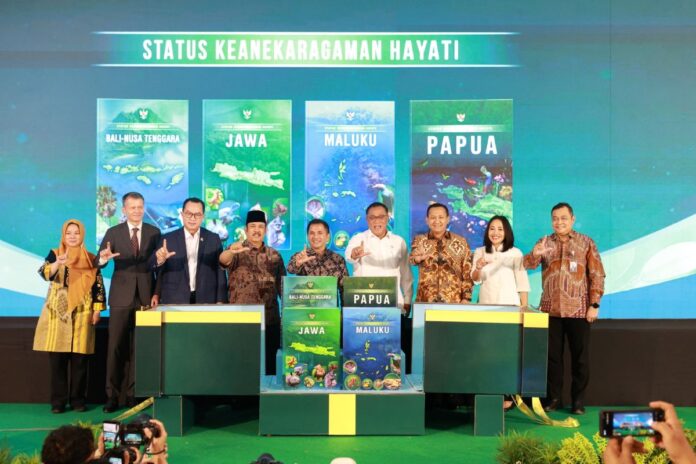
Ecobiz.asia – Indonesia has launched four new regional biodiversity status reports covering Bali–Nusa Tenggara, Java, Maluku, and Papua, providing updated scientific data to support conservation policies and evidence-based development planning.
The reports were jointly launched in Jakarta on Tuesday (July 21, 2026) by the Ministry of National Development Planning (Bappenas), the National Research and Innovation Agency (BRIN), the Ministry of Environment, the Ministry of Forestry, the Ministry of Marine Affairs and Fisheries, and the Ministry of Agriculture, with support from the German government through GIZ Indonesia & ASEAN and Yayasan Konservasi Indonesia.
The reports form part of Indonesia’s efforts to strengthen biodiversity data and scientific information as the foundation for policy formulation and sustainable development planning. They will also support the implementation of the Indonesian Biodiversity Strategy and Action Plan (IBSAP) 2025–2045, which is aligned with the country’s Long-Term National Development Plan (RPJPN) 2025–2045 and Medium-Term National Development Plan (RPJMN) 2025–2029.
The publications provide updated assessments of biodiversity at the ecosystem, species, and genetic resource levels across the four regions, while identifying major threats, conservation challenges, and management priorities.
As one of the world’s megadiverse countries, Indonesia considers biodiversity a strategic natural asset that underpins food, water, and energy security, public health, and the development of the green and blue economies.
“Biodiversity is the source of our future. Every day we benefit from food, fisheries, spices, and medicines that originate from biological resources and form an inseparable part of our lives,” National Development Planning Minister Rachmat Pambudy said during the launch.
He said biodiversity has been integrated into Indonesia’s national development agenda as a key component for achieving environmental sustainability and advancing the green economy.
Environment Minister Mohammad Jumhur Hidayat said the government is preparing several new biodiversity-related policies, including regulations on access and benefit-sharing from genetic resources and governance of biodiversity’s economic value.
“We want to ensure that biodiversity utilization through various policy instruments strengthens conservation efforts while delivering fair benefits to communities, relying on scientific evidence and good governance,” he said.
The government said updating biodiversity information is becoming increasingly important as ecosystems face mounting pressures from climate change, habitat degradation, pollution, unsustainable resource exploitation, and species loss.
BRIN Chair Arif Satria said the agency would continue supporting biodiversity management through research, scientific data, and policy recommendations.
“The launch of these biodiversity status reports marks the beginning of stronger research and innovation to support Indonesia’s biodiversity management. Biodiversity should generate tangible benefits for food security, health, energy, biomaterials, and community welfare,” he said.
Deputy Forestry Minister Rohmat Marzuki said the reports are intended to serve not only as scientific references but also as practical guidance for policymakers and stakeholders involved in biodiversity conservation.
“We hope these documents become a shared reference that encourages concrete action toward sustainable biodiversity management, in line with the vision of living in harmony with nature for the benefit of present and future generations,” he said.
The launch builds on earlier biodiversity assessments published in 2025, including the national biodiversity status report and regional reports covering Sumatra and Sulawesi.
Thomas Graf, Head of Mission of the German Embassy to Indonesia, ASEAN, and Timor-Leste, said Germany would continue supporting Indonesia in translating scientific knowledge into practical conservation and development policies.
The event brought together representatives from government agencies, local administrations, academia, Indigenous and local communities, development partners, civil society organizations, business associations, and the private sector. The government said broad collaboration would be essential for implementing IBSAP 2025–2045 and strengthening biodiversity conservation as a foundation for achieving Indonesia’s Golden Indonesia 2045 vision. ***