

Ecobiz.asia — The Green Climate Fund (GCF) has approved a US$9 million grant for Indonesia to strengthen climate resilience in vulnerable coastal communities in Central Java, marking the country’s first project financed through the fund’s Direct Access Entity (DAE) mechanism.
The funding will support a five-year programme, Building Flood Resilient Community through Adaptive Livelihood and Runoff Management in the Petanglong Area of Central Java (BRAVE), which aims to help communities adapt to tidal flooding, coastal erosion, land subsidence, and increasingly frequent extreme weather driven by climate change.
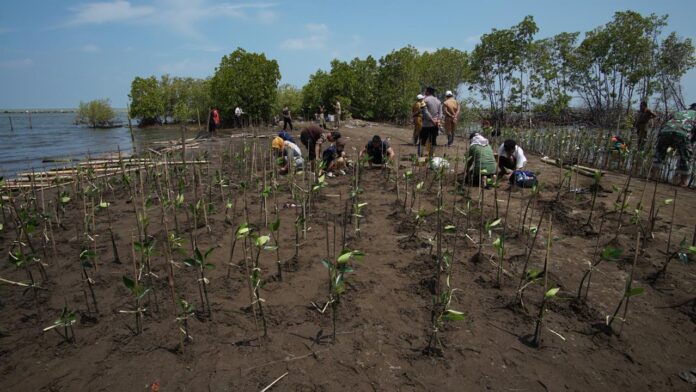
The project will be implemented in Pekalongan City, Pekalongan Regency, and Batang Regency in Central Java. It aims to restore and sustainably manage approximately 3,700 hectares of coastal ecosystems, strengthen climate-resilient livelihoods for farmers and fishers, and improve local climate adaptation governance.
The BRAVE programme is expected to directly benefit 136,360 people while improving climate resilience for more than 1.2 million residents across the Pekalongan-Batang coastal region.
Boby Wahyu Hernawan, Director for Multilateral Cooperation and Sustainable Finance at Indonesia’s Ministry of Finance and Head of the country’s National Designated Authority (NDA) for the GCF, said the approval demonstrates Indonesia’s growing capacity to access and manage international climate finance.
“This achievement shows that national institutions are capable of meeting the Green Climate Fund’s international standards while underscoring the importance of strong national readiness as the foundation for accessing climate finance,” Boby said.
He added that accessing global climate finance requires robust institutional capacity, as proposals must meet stringent standards on environmental and social safeguards, governance, accountability, and scientific integrity.
Hemant Mandal, GCF Regional Director for Asia and the Pacific, described BRAVE as a milestone for both Indonesia and the Green Climate Fund.
“As Indonesia’s first project financed through the Direct Access Entity mechanism, BRAVE demonstrates how country ownership can be translated into concrete climate adaptation action on the ground,” Mandal said.
He added that the project was approved not only for its climate adaptation objectives but also because it strengthens local economic resilience by helping communities better withstand future climate shocks.
The project will be managed by KEMITRAAN, Indonesia’s accredited national entity under the GCF’s Direct Access Entity framework, working with Mercy Corps Indonesia as the executing entity, alongside government agencies, the private sector, academia, and local communities.
KEMITRAAN Executive Director Nurina Widagdo said the approval opens greater opportunities for Indonesia to directly access international climate finance through national institutions.
“This approval demonstrates that Indonesian institutions are capable of managing international climate finance in a transparent and accountable manner. We are proud to contribute to a project that will deliver tangible benefits to communities most affected by climate change,” she said.
Mercy Corps Indonesia Executive Director Ade Soekadis said BRAVE would combine climate adaptation with livelihood development through climate-smart agriculture and aquaculture, blue-green infrastructure, and strengthened climate information systems.
“Our hope is that BRAVE will leave behind lasting knowledge, capacity, and systems that continue strengthening community resilience long after the project has ended,” Ade said. ***