
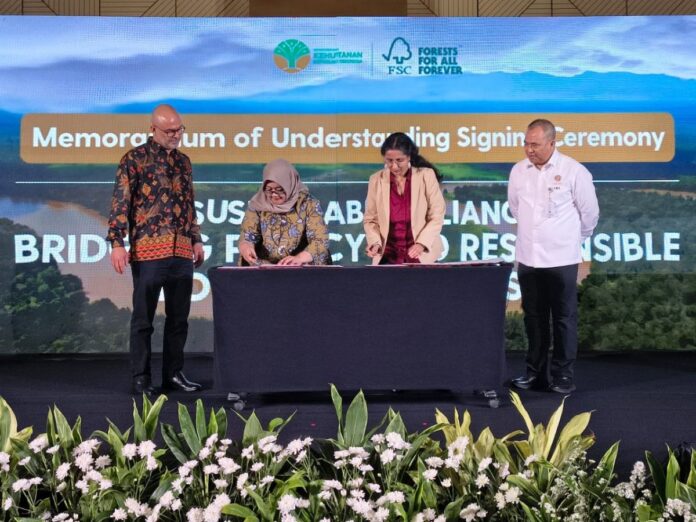
Ecobiz.asia — Indonesia’s Ministry of Forestry and the Forest Stewardship Council (FSC) have signed a strategic partnership to integrate the implementation of Indonesia’s mandatory Timber Legality and Sustainability Assurance System (SVLK) with FSC’s globally recognized voluntary certification scheme through a combined audit mechanism, aiming to strengthen forest governance while expanding international market access for Indonesian forest products.
The Memorandum of Understanding (MoU), signed in Jakarta on Tuesday (June 30, 2026), seeks to create greater synergy between the two certification systems through a combined audit mechanism that reduces duplication, lowers compliance costs, and improves certification efficiency without compromising the credibility of either scheme.
The agreement was signed by Director General of Sustainable Forest Management Laksmi Wijayanti and FSC Director General Subhra Bhattacharjee in the presence of representatives from government agencies, businesses, certification bodies, civil society organizations, and forestry stakeholders from Indonesia and abroad.
Under the partnership, the Ministry of Forestry and FSC will develop integrated audit mechanisms covering the entire forest-products supply chain, from forest management operations to exporters and importers. The cooperation also includes capacity building, market information exchange, promotion of sustainable forest management, alignment of environmental safeguards, and efforts to expand market access for products certified under both SVLK and FSC standards.
Laksmi said the partnership reflects Indonesia’s commitment to strengthening forest governance while improving the competitiveness of its forestry sector.
“Indonesia is firmly committed to ensuring the sustainable and responsible management of its forest resources,” she said.
“Through this collaboration, we aim to strengthen synergies between national and international approaches to sustainable forest management. We expect the development of a combined audit mechanism between SVLK and FSC to strengthen global market confidence in Indonesian forest products while creating greater value for sustainable forest managers across the country.”
Indonesia has developed the SVLK through an inclusive multi-stakeholder process over the past two decades. The mandatory certification system combines independent accredited auditors with third-party monitoring to strengthen forest governance while ensuring the legality, sustainability, transparency, and accountability of forest management.
The system gained international recognition when Indonesia became the first country in the world to implement the Forest Law Enforcement, Governance and Trade (FLEGT) licensing scheme with the European Union. Authorities have continued to enhance the system, including by introducing geolocation features to improve the traceability of timber products to their forest origins.
Backed by the SVLK, Indonesia’s exports of timber and wood products have averaged around US$12.5 billion over the past three years.
Bhattacharjee said the partnership would help Indonesian producers respond to growing global demand for legally verified, traceable, and deforestation-free forest products.
“As buyers worldwide increasingly require deforestation-free supply chains, Indonesian producers that cannot demonstrate legality, traceability, and responsible forest management risk losing access to key markets,” he said. “Through the development of the SVLK–FSC combined audit mechanism, we are streamlining our efforts while creating broader economic opportunities for Indonesian forestry businesses.”
Purwadi Soeprihanto, Secretary General of the Indonesian Forest Concession Holders Association (APHI), welcomed the agreement, describing it as an important first step toward expanding market acceptance for Indonesia’s sustainably managed forest products.
He said the partnership could eventually be broadened beyond timber certification to include non-timber forest products and environmental services, as FSC develops new certification frameworks for ecosystem services and multiple forest-use businesses.
“We hope this cooperation will continue to expand in line with Indonesia’s efforts to promote multi-business forestry,” Purwadi said. “In the future, we expect internationally recognized certification to support not only timber products, but also non-timber forest products and environmental services, further strengthening the global competitiveness of Indonesia’s forestry sector.” ***