

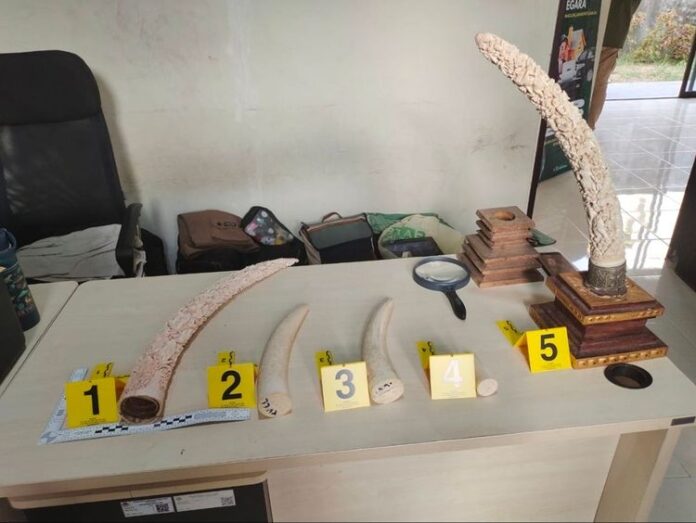
Ecobiz.asia — Indonesian forestry law enforcement authorities have completed the investigation into an alleged illegal elephant ivory trade case in Bali after prosecutors declared the case file complete for trial.
According to a statement released on Thursday (June 4, 2026), the case was uncovered by the Forestry Law Enforcement Agency (Gakkumhut) under Indonesia’s Ministry of Forestry after its Cyber Patrol Team detected Facebook posts offering suspected wildlife products made from protected animal parts.
The investigation was handled by the Java, Bali, and Nusa Tenggara Regional Forestry Law Enforcement Office in Gianyar Regency, Bali.
Director General of Forestry Law Enforcement Dwi Januanto Nugroho said the illegal trade in elephant ivory remains a serious threat to Indonesia’s biodiversity conservation efforts.
“The trade in elephant ivory and other protected wildlife body parts is a serious threat to Indonesia’s biodiversity,” Dwi said in the statement.
“As long as these items are still viewed as collectibles, decorations, or valuable commodities, illegal hunting and wildlife trafficking will continue to have a market,” he added.
Dwi stressed that conservation law enforcement is aimed not only at prosecuting offenders but also at dismantling illegal supply chains involving protected wildlife parts.
“Protected wildlife is not a commodity. Indonesia’s biodiversity must be preserved as a living national heritage, not traded as dead objects,” he said.
Following the cyber investigation, authorities conducted inspections at an art shop in Tampaksiring, Gianyar, on April 14, 2026. The operation continued the following day in coordination with Bali Police investigators at two separate locations in Gianyar.
During the raids, officers confiscated several handicrafts, carvings, and other items suspected of being made from elephant ivory. Investigators believe the products were being traded as collectibles and craft items.
Based on the investigation, authorities named an individual identified by the initials IKS as a suspect in the case. Investigators also secured court approval from the Denpasar District Court for the seizure of evidence before prosecutors declared the case file complete.
Head of the Java, Bali, and Nusa Tenggara Regional Forestry Law Enforcement Office, Aswin Bangun, said cases involving protected wildlife parts disguised as handicrafts require detailed legal verification.
“Investigators must establish the type of material involved, the protection status of the wildlife species, possession of the items, and the commercial elements of the trade,” Aswin said.
He added that the suspect and evidence would soon be transferred to prosecutors for trial proceedings.
The suspect has been charged under Indonesia’s Law No. 32 of 2024 on Conservation of Biological Natural Resources and Ecosystems, which prohibits the possession, transportation, storage, and trade of protected wildlife parts. ***