
Ecobiz.asia — Indonesia’s state-owned plantation company PT Agrinas Palma Nusantara is exploring a partnership with a South Korean consortium to develop green energy and value-added products from palm oil waste, including biopellets, biochar, carbon-based fertilizers, and biodiesel.
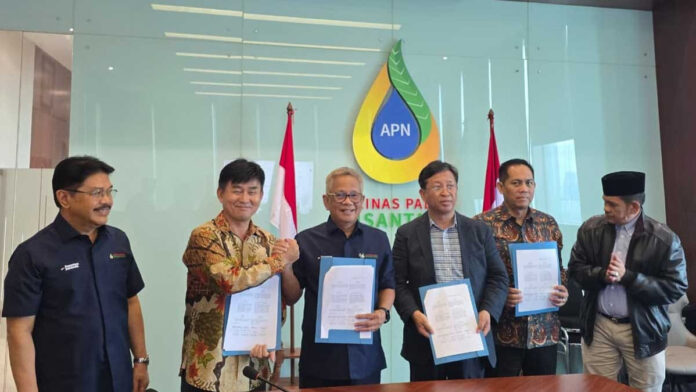
The potential collaboration was discussed during a business meeting in Jakarta attended by Agrinas Palma President Director Mohammad Abdul Ghani and representatives of PT Astrum Dunia Inovasi, Hwasung Tech-Win Co., Ltd., and PT Siborong Nusa Gemilang.
A key focus of the proposed partnership is the utilization of Empty Fruit Bunches (EFB), a by-product of palm oil processing that remains underutilized across much of Indonesia’s palm oil industry.
By integrating South Korean biomass processing technologies, EFB could be converted into renewable energy products and environmentally friendly materials with growing market demand amid the global transition toward low-carbon development.
Mohammad Abdul Ghani said the initiative aligns with Agrinas Palma’s strategy to strengthen sustainable business development while increasing the value generated from Indonesia’s plantation sector.
“The development of green energy and biomass utilization is part of Agrinas Palma’s efforts to build a business that is not only economically productive but also delivers benefits for the environment and society,” Ghani said in a statement.
He added that cooperation with South Korean partners could also support the development of export-oriented downstream plantation products and accelerate the company’s transformation into a globally competitive modern agro-industrial enterprise.
During the meeting, the South Korean consortium presented a range of biomass conversion technologies that could potentially be integrated into Agrinas Palma’s existing palm oil processing facilities.
Beyond producing renewable energy and low-carbon materials, the biomass utilization initiative is also expected to contribute to greenhouse gas emissions reductions and create opportunities for carbon market projects.
As a next step, both parties will exchange technical information, prepare cooperation proposals, and conduct feasibility studies to determine the most viable business model for developing palm biomass-based green energy projects. ***