
Ecobiz.asia – Indonesia’s state-owned energy company PT Pertamina has partnered with the West Java provincial government to develop low-carbon hydrogen, biomethane, and waste-based biofuels by utilizing methane emissions from the Sarimukti landfill, marking another step in the country’s effort to build an integrated clean energy ecosystem.
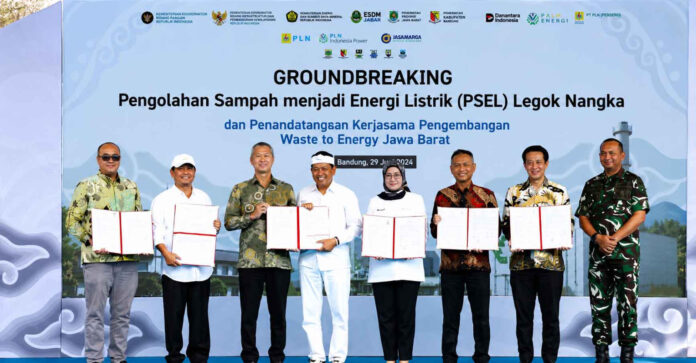
The partnership was formalized through the signing of a cooperation agreement in Bandung on Tuesday (July 29), covering renewable energy development, environmental management, and community empowerment.
Emma Sri Martini, Pertamina’s Director of Strategy, Portfolio and Business Development, said one of the flagship initiatives under the partnership is the utilization of methane gas generated at the Sarimukti landfill in West Bandung Regency.
Under the plan, landfill gas will be upgraded into biomethane before being further processed into low-carbon hydrogen as part of an integrated waste-to-energy value chain.
“The collaboration covers several strategic areas, including waste management at the Sarimukti landfill. Organic waste will be converted into biogas, which will then be processed into biomethane and low-carbon hydrogen,” Emma said.
She said the project would involve multiple Pertamina subsidiaries to establish an integrated clean energy value chain, ranging from feedstock supply and processing to infrastructure development and energy distribution.
The initiative will be implemented jointly by Pertamina New & Renewable Energy (Pertamina NRE) and Pertamina’s gas subholding.
“Each entity will contribute according to its expertise, from feedstock management and processing to infrastructure development, distribution and commercialization,” she said.
Emma added that the project would also involve international technology partners, including South Korea’s Hyundai, to accelerate the deployment of low-carbon energy technologies.
“We see this as a strong collaboration between Pertamina, the West Java provincial government and international partners to advance low-carbon energy, particularly hydrogen. We hope this project will become a pilot model for developing Indonesia’s hydrogen ecosystem,” she said.
According to Emma, the business model could be replicated in other regions if the project proves successful.
Beyond supporting Indonesia’s energy transition, the initiative is also expected to improve waste management while delivering environmental and social benefits.
“As an energy company, Pertamina is committed to ensuring that business development goes hand in hand with environmental sustainability. We hope this collaboration will benefit all stakeholders while encouraging greater community participation through our sustainable development and community empowerment programs,” she said.
On the same occasion, the West Java provincial government also launched construction of the Legok Nangka waste-to-energy (WTE) plant at the Regional Waste Processing and Final Disposal Facility (TPPAS) Legok Nangka.
The facility is designed to process approximately 2,000 tonnes of municipal waste per day into around 40 megawatts (MW) of electricity. In addition to power generation, the project is expected to support future production of hydrogen and biomethane while reducing pressure on the Sarimukti landfill, which currently serves as the primary waste disposal site for the Greater Bandung region. ***