
ASEAN Must Not Become Global Waste Dumping Ground, Circular Economy Must Advance

MORE ARTICLES

Ecobiz.asia — Indonesia has called for stronger regional cooperation in ASEAN to address increasingly complex challenges in chemical and waste management, including the growing risks of cross-border waste movement.

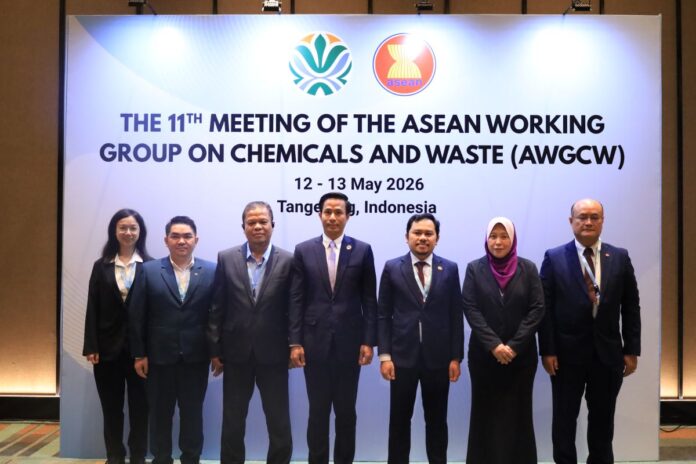
The commitment was highlighted during the 11th Meeting of the ASEAN Working Group on Chemicals and Waste (AWGCW), held on May 12–13, 2026, in Tangerang, Banten.

Acting Deputy for Waste, Hazardous Waste, and Hazardous Substances Management at Indonesia’s Ministry of Environment and Environmental Control Agency, Laksmi Widyajayanti, said chemical and waste management can no longer be viewed solely as a national responsibility.

“Sound management of chemicals and waste can no longer be regarded merely as a national task, but must become a collective global movement. Without international cooperation, it will be impossible to combat illegal cross-border waste trafficking and realize a circular economy in this region,” Laksmi said in a statement on Wednesday (May 13, 2026).

Read also:  Pertamina to Start Producing 100 Kg/Day of Green Hydrogen at Ulubelu Pilot in November

AWGCW Chair from Malaysia, Mahadi Bin Sukarno, stressed that ASEAN must not become a destination for global waste dumping amid the region’s rapid economic growth.

“As a rapidly developing region, ASEAN must not become a global waste dumping ground. This meeting is important to align policy directions so we can balance economic progress with environmental protection and public health. We must ensure ASEAN remains free from chemical and waste pollution through concrete action, not merely annual meetings,” Mahadi said.

Read also:  Two Sumatran Rhinos Pregnant at Way Kambas Breeding Facility, Raising Hopes for Population Recovery

During the two-day meeting, Indonesia’s Ministry of Environment facilitated discussions on seven priority programs under the AWGCW Action Plan, including the adoption of environmentally friendly technologies for green industries, emergency response mechanisms for chemical accidents, and remediation of contaminated land.

Indonesia also pushed for harmonized operational standards among member states to strengthen regional preparedness in implementing international environmental agreements, including the Basel Convention, Minamata Convention on Mercury, and the Montreal Protocol.

The forum also served as a platform for exchanging circular economy innovations, focusing on waste management approaches that not only reduce environmental impacts but also create sustainable economic value.

Read also:  Verra’s CCS Methodology Secures ICVCM Approval Under Core Carbon Principles

The outcomes of the meeting will help guide Laos, which is set to assume the AWGCW chairmanship in 2027.

The meeting was attended by delegates from Brunei Darussalam, Cambodia, Indonesia, Malaysia, Myanmar, Laos, Philippines, Singapore, Thailand, Vietnam, Timor-Leste, and the Association of Southeast Asian Nations Secretariat.

International partners participating in the forum included the Asian Institute of Technology, the Embassies of Denmark and Finland, and the Economic Research Institute for ASEAN and East Asia. ***
LATEST STORIES

MORE ARTICLES

PLN Develops Time-Based Renewable Energy Certificates to Track Hourly Green Power Use

Ecobiz.asia – Indonesia’s state-owned electricity company PT PLN (Persero) plans to launch Time-based Renewable Energy Certificates (T-REC) in 2028, allowing customers to track renewable...

Gold Standard Launches G-RESET Methodology to Expand Carbon Finance for Renewable Energy Projects

Ecobiz.asia – Carbon standard setter Gold Standard has launched a new methodology to expand carbon credit certification pathways for renewable energy, energy storage and...

Global Wildlife Populations Fall 73%, but Recovery Is Still Possible

Ecobiz.asia – The average size of monitored wildlife populations has fallen 73% over the past 52 years, highlighting the scale of the global biodiversity...

Indonesia Plans Special Unit to Tackle Methane, Black Carbon Emissions by 2027

Ecobiz.asia — Indonesia is preparing to establish a special unit to coordinate efforts to reduce emissions of super pollutants such as methane and black...

APP Group Becomes First Indonesian Company to Join RE100, Targets 100% Renewable Electricity

Ecobiz.asia – APP Group has become the first Indonesian company to join RE100, a global initiative led by The Climate Group that brings together...

TOP STORIES

Komunitas Iklim Asia Tenggara Desak Bank Dunia dan IMF Alihkan Pembiayaan ke Ekonomi Regeneratif

Ecobiz.asia – Komunitas iklim Asia Tenggara mendesak Bank Dunia (World Bank) dan Dana Moneter Internasional (IMF) mengubah arah kebijakan pembiayaan global dengan mengutamakan pemulihan...

KLH Dorong Pemda Siapkan Proyek Karbon, Bisa Jadi Sumber Pendapatan Daerah

Ecobiz.asia – Kementerian Lingkungan Hidup (KLH)/Badan Pengendalian Lingkungan Hidup (BPLH) mendorong pemerintah daerah mulai mengidentifikasi dan menyiapkan proyek-proyek karbon agar dapat memanfaatkan peluang perdagangan...

Pertamina EP Sangasanga Field Dukung Kelompok Wanita Tani Pertanian Hidroponik

Ecobiz.asia – Kelompok Wanita Tani (KWT) Rosella di Kelurahan Sarijaya, Kecamatan Sangasanga, Kabupaten Kutai Kartanegara, Kalimantan Timur, berhasil memanen buah melon premium melalui budidaya...

PHR Perkuat Budaya Inovasi melalui CIIF 2026, Cetak Added Value Creation Rp3,73 Triliun

Ecobiz.asia – PT Pertamina Hulu Rokan (PHR) mencatat nilai tambah (added value creation) Rp3,73 triliun dari berbagai inovasi dan program perbaikan operasional yang dikembangkan...

Negara-Negara Asia-Pasifik Perkuat Kolaborasi untuk Tata Kelola Hutan dan Implementasi REDD+

Ecobiz.asia — Kementerian Kehutanan (Kemenhut) bekerja sama dengan Sekretariat Konvensi Kerangka Kerja PBB tentang Perubahan Iklim (UNFCCC) menggelar pertemuan regional untuk memperkuat implementasi pengurangan...