
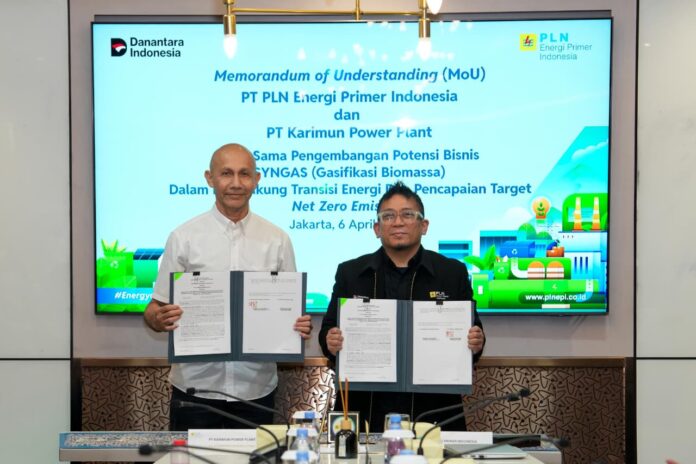
Ecobiz.asia — PT PLN Energi Primer Indonesia (PLN EPI) is advancing biomass gasification as part of efforts to accelerate Indonesia’s diesel-to-gas conversion program, particularly in remote areas not connected to the main power grid.
The initiative was marked by the signing of a memorandum of understanding (MoU) with PT Karimun Power Plant (KPP) on April 6, 2026, in Jakarta to develop biomass-based syngas business.
PLN EPI Biomass Director Hokkop Situngkir said biomass utilization is a key component in building an integrated renewable energy ecosystem from upstream to downstream.
“Indonesia’s biomass potential is estimated at around 80 million tons, but only about 20 million tons have been utilized, leaving significant room to support national energy security,” he said.
He added that biomass development is not only focused on co-firing at coal-fired power plants but also through gasification, which produces syngas that can be used in diesel power plants and isolated electricity systems.
“Biomass gasification offers a solution for regions still reliant on diesel, as it can reduce energy costs while lowering emissions,” Hokkop said.
He noted that limitations in coal plant design and infrastructure readiness remain challenges for co-firing, making gasification a strategic alternative.
As an initial step, PLN EPI and KPP will develop a pilot project in Karimun. The existing facility currently has a biomass capacity of around 1 MW, with potential expansion to between 2 MW and 5 MW.
KPP Director Arthur Palupessy said the main challenge in biomass development lies in ensuring stable pricing and long-term feedstock supply.
“A 1 MW power plant requires around 35 tons of biomass per day, so a reliable long-term supply chain is essential,” he said.
Meanwhile, PT BEST YPK President Director Lutfi Nazi said at least eight biomass potential sites have been identified across Indonesia, including in Riau Islands and Sulawesi, which could support electrification in remote areas.
Under the partnership, PLN EPI will act as an aggregator and ecosystem developer, covering feedstock mapping, production facility development, gasification technology provision, and syngas distribution.
The model is expected to be replicated across around 200 diesel power plant locations nationwide to reduce diesel consumption and accelerate Indonesia’s energy transition. ***