

Ecobiz.asia — Indonesia aims to generate up to US$7.7 billion annually from high-integrity carbon trading as part of its strategy to drive green, inclusive, and resilient economic growth.
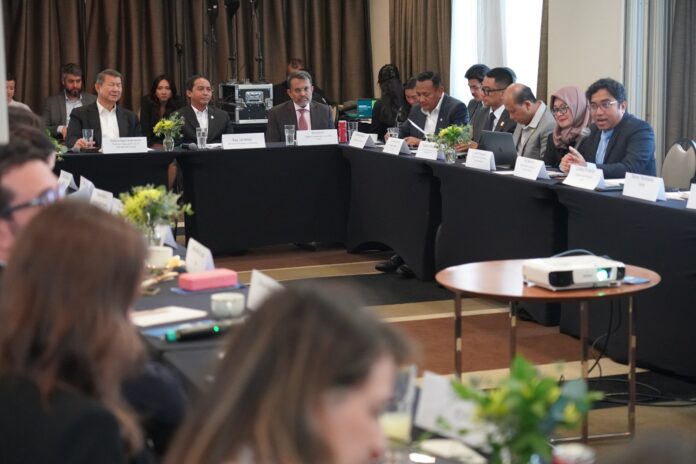
Speaking at the High-Level Breakfast Roundtable at Sustainable Business COP30 (SBCOP) in São Paulo, Brazil, Saturday (Nov. 8, 2025) Forestry Minister Raja Juli Antoni said the government’s carbon market policy is designed to ensure every ton of traded emissions is traceable, verifiable, and accountable.
“Our goal is to mobilize up to US$7.7 billion per year through carbon transactions while ensuring transparency and accountability,” he said, emphasizing that Indonesia’s forestry sector plays a key role in producing high-quality carbon credits.
The event, themed “Indonesia’s High-Integrity Carbon Market: Toward a Green, Resilient, and Inclusive Future,” was held on the sidelines of COP30 UNFCCC and co-hosted by the Ministry of Forestry, Standard Chartered, the Indonesia Climate and Growth Dialogue (ICGD), the Business Partnership for Market Implementation (BPMI), and the International Emissions Trading Association (IETA). It brought together global investors and business leaders.
Special Envoy for Climate and Energy Hashim Djojohadikusumo told participants that President Prabowo Subianto had signed Presidential Regulation No. 110/2025 on the Carbon Economic Value (NEK) and National Greenhouse Gas Emission Control, establishing the legal foundation for a credible, transparent carbon market aligned with international standards.
“This regulation paves the way for a high-integrity carbon market that provides tangible benefits for local communities,” Hashim said. He added that Indonesia’s ambition is to become a leading global carbon market hub that delivers measurable climate impact while creating jobs and sustainable livelihoods.
Raja said the forestry ministry is preparing four derivative regulations to strengthen market governance, including revisions to Environment and Forestry Ministerial Regulation No. 7/2023 on carbon trading procedures in the forestry sector, and a new regulation on the use of ecosystem services in conservation areas.
“At its core, this policy transforms forest protection into a productive and sustainable economic activity,” Raja said.
Standard Chartered Indonesia CEO Donny Donosepoetro OBE welcomed the new regulation as a major milestone. “This presidential decree marks a long-awaited breakthrough, laying a solid foundation for a credible and investment-worthy carbon market,” he said.
At the same forum, the Ministry of Forestry and the Integrity Council for the Voluntary Carbon Market (ICVCM) signed a memorandum of understanding to strengthen Indonesia’s voluntary carbon market integrity.
The partnership will focus on capacity building, technical assistance, and aligning Indonesia’s forestry carbon credits with the Core Carbon Principles (CCPs) — the global benchmark for credible, high-integrity carbon credits.
Indonesia’s move signals its determination to ensure the national carbon market delivers measurable climate benefits while safeguarding communities and ecosystems. ***