

Ecobiz.asia — Indonesia’s Ministry of Forestry said it is reinforcing the role of Forest Management Units (KPH) as the frontline of the country’s forestry transformation, including efforts to expand community access and implement the newly launched national carbon market.
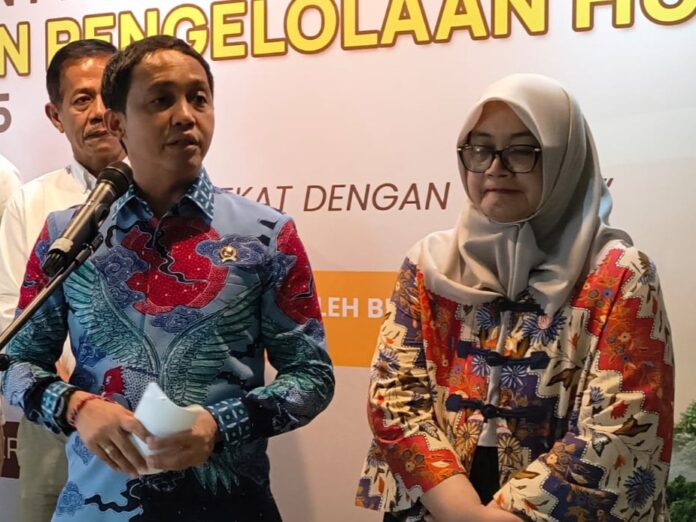
Director-General of Sustainable Forest Management Laksmi Wijayanti said the opening of the national carbon market marks a strategic step that positions Indonesia as a key supplier of high-integrity carbon credits in the global market.
“The launch of the national carbon market, now linked to mandatory, high-standard mechanisms, is a major milestone for Indonesia to become a central actor in the global carbon market, particularly from the forestry sector,” Laksmi said on Friday (Nov. 21, 2025).
She said the decision places Indonesia among the first tropical countries able to supply traceable carbon credits—sourced from industrial forest permits (PBPH), social forestry schemes, customary forests, and conservation areas under ecosystem restoration.
Laksmi added that Indonesia’s ability to provide credible forest-based carbon credits has drawn international attention at a time when global markets face stagnating supplies of high-quality credits.
As a foundation for the carbon market’s credibility, strengthening KPH will be a top priority, she said. KPH are expected to act as landscape-based management hubs that ensure carbon integrity, increase forest productivity, and expand green economic benefits for local communities.
“With stronger KPH institutions and the opening of the national carbon market, Indonesia underscores its position as a global leader in the green economy—building fair forest-based economic value and reinforcing its contribution to climate-mitigation efforts,” she said.
Laksmi added that the strengthening of KPH is not only technical but strategic, enabling them to align national interests, the private sector, and communities.
KPH are expected to lead collaboration across PBPH holders, social-forestry groups, customary-forest communities, and private companies to restore fragmented forests, diversify livelihoods, and accelerate green investment. ***