
Ecobiz.asia — Indonesia and Singapore are advancing plans for cross-border clean electricity exports while exploring new collaboration on low-carbon technologies, including Carbon Capture and Storage (CCS).
Indonesia’s Bahlil Lahadalia, Minister of Energy and Mineral Resources, said the industrial zone that will serve as the base for the project in the Batam–Bintan–Karimun (BBK) region in Riau Islands is nearing completion.
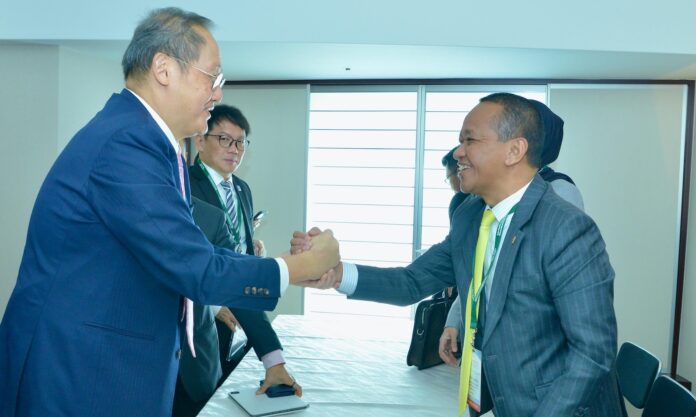
“I have received reports that the industrial zone is almost finalized. It will be developed in the Riau Islands. Once this is completed, it will mark important progress in the preparation stage,” Bahlil said after meeting Tan See Leng, Singapore’s Minister for Manpower who also oversees the energy sector, in Tokyo, Japan, on Sunday (March 15, 2026).
According to Bahlil, the clean electricity export project is designed not only as an energy trade initiative but also to attract global companies to build production facilities and technology centers in the BBK area, positioning the region as a new green industrial hub in Indonesia.
Tan See Leng welcomed the progress in bilateral discussions, noting that most of the technical negotiations between the two countries had moved forward positively.
“I think most of the technical discussions have made good progress,” he said.
In addition to electricity exports, the two governments are also discussing the development of sustainable industrial zones in Batam, Bintan and Karimun. Indonesia is preparing a policy framework to ensure that domestic electricity demand remains a priority before exports are carried out.
During the meeting, both sides also opened the possibility of collaboration in low-carbon technologies, including CCS.
“Regarding CCS, the regulations have been prepared. We can proceed with collaboration in this area,” Bahlil said.
For the electricity supply, Indonesia has proposed power generated from solar power plants as part of the country’s broader plan to develop up to 100 gigawatts (GW) of power generation capacity in the future national power system.
However, Bahlil acknowledged challenges related to pricing, as electricity generated from renewable sources generally remains more expensive than power produced from fossil fuels.
Both ministers said the cooperation represents an important step toward strengthening energy leadership in the ASEAN region. With Singapore’s technology and investment support and Indonesia’s abundant energy resources, pilot implementation of the project in the BBK area is expected to begin soon as a follow-up to three previously signed memorandums of understanding. ***