

Ecobiz.asia — Indonesia could dramatically reduce transport emissions, strengthen energy security and save trillions of rupiah in fuel subsidies by electrifying its freight truck fleet, but policy uncertainty and a lack of coordinated investment continue to delay the transition, according to a new study released on Wednesday (June 17, 2026).
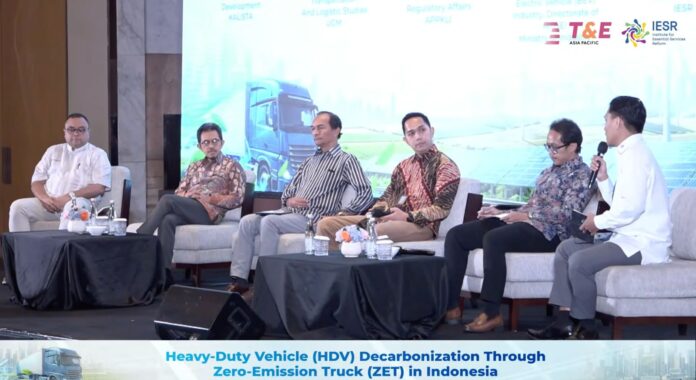
The findings were presented during the launch of Zero Emission Trucks in Indonesia: A Policy and Regulatory Roadmap for Heavy and Medium Duty Freight, a joint study by the Institute for Essential Services Reform (IESR) and Transport & Environment Asia Pacific.
The report describes freight transport decarbonization as a critical component of Indonesia’s energy transition, marking the country’s first comprehensive roadmap for achieving zero-emission trucks (ZETs).
Indonesia’s transport sector is the country’s third-largest source of energy-related emissions. In 2024, the sector generated 168 million tonnes of carbon dioxide equivalent (MtCO2e), accounting for around 25% of national emissions. Road transport dominates the sector, contributing 88% of total transport emissions.
Although trucks represent only about 4% of Indonesia’s vehicle fleet, they account for 31% of road transport emissions, or approximately 42.6 MtCO2e. Medium-duty trucks contribute more than half of freight-related emissions, while heavy-duty trucks account for another 13%.
According to IESR’s modeling, a full transition to zero-emission trucks by 2060 could reduce final energy demand by 78% compared with a business-as-usual scenario while cutting tailpipe emissions by 99%.
The study found that electric trucks are between 62% and 87% more energy efficient than diesel-powered vehicles. Replacing conventional trucks with electric alternatives could substitute 207.5 million barrels of oil equivalent (MMBOE) in liquid fuels with only 29.2 MMBOE of electricity demand.
Despite the environmental and economic benefits, the report found that electric trucks remain more expensive than diesel vehicles under Indonesia’s current subsidized fuel regime. Cost parity would only be achieved through a combination of battery-swapping systems, fiscal incentives and diesel prices of around IDR 8,000–9,000 per litre, compared with the current subsidized price of approximately IDR 6,800 per litre.
Government officials and industry representatives acknowledged that the transition is being slowed by a lack of alignment among policymakers, vehicle manufacturers and charging infrastructure providers.
Patia Jungjungan Manindo, Head of the Battery Electric Vehicle Industry Team at the Ministry of Industry, described the situation as a three-way stalemate.
“Industry wants the infrastructure to exist first before they come in. The government wants investors to commit first before the incentives come. And the charging investors want lots of vehicles on the road first before they invest,” Patia said.
“Everyone is waiting on everyone else. Nobody wants to go first.”
Patia said the government has yet to design dedicated incentives for electric trucks because there are currently no domestic manufacturers producing them. For the same reason, heavy-duty trucks were excluded from import-duty and tax incentives granted to electric passenger vehicles and buses in 2024 and 2025.
The charging industry echoed those concerns.
Benhur Lumbantobing, Head of Regulatory Affairs at the Indonesian Electric Vehicle Charging Operators Association (APPKLI), said heavy-duty truck infrastructure is absent from the government’s current charging development plans.
“The Energy Ministry’s charging roadmap runs to 2030, but I don’t see any heavy-duty truck infrastructure in it,” he said.
To accelerate adoption, IESR proposed three key policy measures.
First, the government should introduce fuel-efficiency standards that improve by at least 10% annually to reduce emissions and improve fleet efficiency.
Second, Indonesia should encourage vehicle manufacturers already operating in the country to introduce electric truck models currently sold in overseas markets. The report recommends extending import-duty incentives previously granted to imported electric passenger vehicles to the zero-emission truck segment, while requiring manufacturers to invest in supporting infrastructure.
Third, the study recommends developing charging stations every 100 kilometers along major freight corridors. By 2030, Indonesia would require at least 230-kW chargers at 27 strategic locations across Java and Sumatra to support the early deployment of electric freight vehicles.
IESR also called for reforms to financing mechanisms, including low-interest leasing schemes, battery-swapping business models and longer loan tenors to reduce upfront investment costs for fleet operators.
Fabby Tumiwa, Executive Director of IESR, said the debate should no longer focus on whether zero-emission trucks are technically feasible.
“The question is no longer whether we can, or whether we must,” Fabby said. “The real question is when we start, and how serious we are about it.” ***