

Ecobiz.asia — Indonesia may increase the use of crude palm oil (CPO) to produce biodiesel if global oil supplies become difficult to secure amid geopolitical uncertainty, Energy and Mineral Resources Minister Bahlil Lahadalia said on Sunday (March 15, 2026).
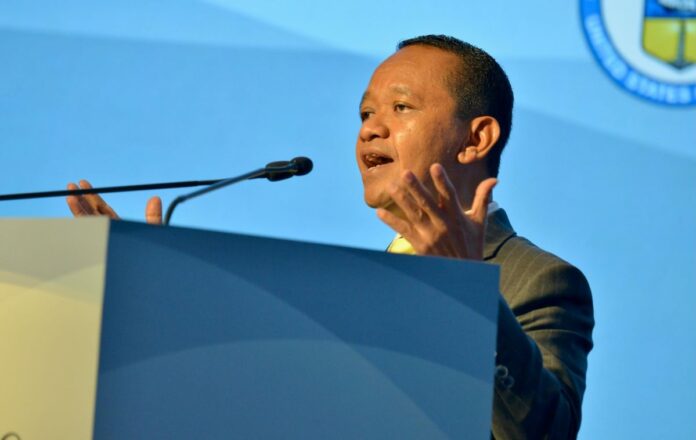
Speaking at the Indo-Pacific Energy Security Ministerial and Business Forum in Tokyo, Japan, Bahlil said Indonesia, as a net oil importer, would need to rely more on domestic energy resources if access to global oil supplies becomes constrained.
“As one of the oil-importing countries, if we cannot secure our oil supply, we will have no choice but to utilize our domestic energy potential, including increasing the share of crude palm oil converted into biodiesel,” Bahlil told delegates at the forum.
The event brought together energy ministers and industry leaders from across the Indo-Pacific region to discuss energy supply security amid global market volatility.
Bahlil said the current uncertainty in global energy supply requires countries in the region to strengthen mutually beneficial cooperation.
“In the current situation of global energy supply uncertainty, we must strengthen collaboration that lifts each other up rather than undermines one another,” he said.
He also highlighted Indonesia’s role in supporting global energy supply stability. In 2025, the country shipped around 150 cargoes of liquefied natural gas (LNG) to international markets.
Indonesia is also one of the world’s largest suppliers of coal, accounting for roughly half of global seaborne coal trade, according to the minister.
Bahlil said these exports demonstrate Indonesia’s contribution to maintaining global energy supply amid geopolitical tensions, including conflicts in the Middle East that have raised concerns about supply stability.
However, he noted that countries ultimately tend to prioritize their domestic energy needs when global supply pressures intensify.
Indonesia is the world’s largest producer and exporter of crude palm oil, with exports reaching about 30 million tons per year.
Despite the focus on energy security, the government reiterated its commitment to energy transition and renewable energy development. One of the flagship initiatives currently being prepared is the development of up to 100 gigawatts (GW) of solar power capacity under the direction of President Prabowo Subianto.
“Indonesia remains strongly committed to accelerating the energy transition, including through the development of 100 GW of solar power, with the short-term priority of replacing diesel power plants with solar-based generation,” Bahlil said.
The Tokyo forum was co-hosted by Ministry of Economy, Trade and Industry and the National Energy Dominance Council. The meeting concluded with a joint statement emphasizing the importance of strengthening energy security in the Indo-Pacific region while respecting each country’s chosen energy transition pathway.