
Ecobiz.asia – Indonesia and Japan have agreed to accelerate the implementation of Joint Crediting Mechanism (JCM) carbon projects while expanding cooperation on clean energy initiatives, including geothermal power, waste-to-energy, sustainable aviation fuel (SAF), green ammonia, and carbon market development.
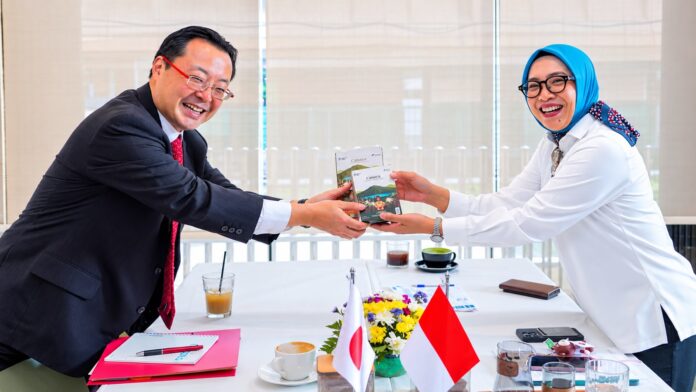
The commitment was reaffirmed during a bilateral meeting between Indonesia’s Directorate General of New, Renewable Energy and Energy Conservation (EBTKE) under the Ministry of Energy and Mineral Resources and a delegation from Japan’s Ministry of Economy, Trade and Industry (METI) in Jakarta on Wednesday (July 16, 2026).
Eniya Listiani Dewi, Director General of EBTKE, said the partnership is focused on accelerating strategic clean energy projects while strengthening investment in low-carbon technologies.
One of the priority areas discussed was the acceleration of two geothermal developments—Sarulla Geothermal Power Plant and Muaralaboh Geothermal Power Plant Unit 2.
“We are accelerating the development of the Sarulla and Muaralaboh Unit 2 geothermal projects. For Sarulla, the government continues to restore generation capacity through a three-phase Long-Term Restoration Plan while providing greater certainty for follow-on investment to optimize the plant’s capacity,” Eniya said.
She added that the Muaralaboh Unit 2 project is expected to increase the share of renewable energy in Indonesia’s power mix, strengthen the reliability of Sumatra’s electricity system, create jobs, increase the use of locally produced goods, and generate broader economic benefits.
Beyond geothermal energy, the two countries discussed several priority projects, including the Legok Nangka waste-to-energy plant in West Java, the Green Ammonia Initiative in Aceh (GAIA), sustainable aviation fuel development, small- and medium-scale nuclear power generation, and carbon market cooperation.
Indonesia and Japan also agreed to accelerate the implementation of the Joint Crediting Mechanism (JCM), including projects involving carbon capture and storage (CCS) and internationally recognized carbon trading mechanisms.
The JCM is a bilateral carbon crediting framework established by Japan to support the deployment of low-carbon technologies in partner countries while generating verified emission reductions that can be shared between participating governments.
On energy efficiency, Eniya said Indonesia continues to strengthen energy management in industrial facilities and commercial buildings through new regulations. As of 2025, hundreds of industrial facilities and buildings had submitted reports through the government’s Online Energy Management Reporting (POME) platform.
“These measures contribute to both energy savings and greenhouse gas emission reductions,” she said.
Eniya was accompanied by senior officials responsible for geothermal energy, energy conservation, and new energy development, while the Japanese delegation was led by Shinichi Kihara, Director General for Energy and Environmental Policy at Japan’s Agency for Natural Resources and Energy (ANRE).
The meeting underscored both countries’ commitment to expanding clean energy cooperation through increased investment and faster implementation of low-carbon projects to support Indonesia’s energy transition goals. ***