

Ecobiz.asia — Indonesia has called on the global community to collaborate in sustainable mangrove management through the World Mangrove Center (WMC), an international hub for sharing knowledge, best practices, and innovations in coastal ecosystem management.
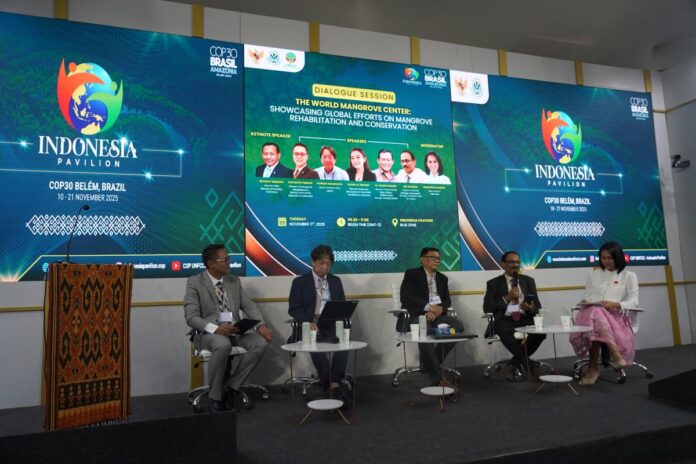
Deputy Forestry Minister Rohmat Marzuki made the call during a dialogue session titled “World Mangrove Center: Showcasing Global Efforts on Mangrove Rehabilitation and Conservation” at the Indonesia Pavilion during the UNFCCC COP30 Climate Conference in Belém, Brazil, on Tuesday (Nov. 11, 2025).
Rohmat said Indonesia’s leadership through the WMC goes beyond symbolism, representing a concrete, science-based, and innovation-driven effort to promote sustainable mangrove management and empower coastal communities.
“Indonesia is strengthening international collaboration through various platforms, both bilateral and multilateral, such as UNEA, UNFCCC, CBD, and South–South Cooperation,” he said.
Indonesia hosts the world’s largest mangrove area, covering 3.44 million hectares, which plays a vital role in climate change mitigation and adaptation while supporting the livelihoods and welfare of coastal communities.
Since the Paris Agreement in 2016 and Indonesia’s G20 presidency in 2022, the country has demonstrated strong commitment and concrete actions in mangrove rehabilitation and conservation. These efforts form part of Indonesia’s strategy to achieve the FOLU Net Sink 2030 target under its Nationally Determined Contribution (NDC).
“Indonesia bears a major responsibility and is positioning itself as a global leader in mangrove restoration and conservation,” Rohmat emphasized.
Speakers from Sri Lanka’s Ministry of Environment, Japan International Cooperation Agency (JICA), the World Bank, and the Global Green Growth Institute (GGGI) joined the session, highlighting the need for stronger multistakeholder partnerships, resource mobilization, and sustainable financing to support mangrove management.
The JICA representative underscored the importance of strengthening the role of the Bali Mangrove Information Center within the WMC framework as an international collaboration and knowledge hub.
In his closing remarks, Rohmat reaffirmed Indonesia’s readiness to lead and inspire global cooperation through the WMC, promoting inclusive collaboration to combat environmental degradation and curb climate change through sustainable mangrove conservation and rehabilitation. ***