

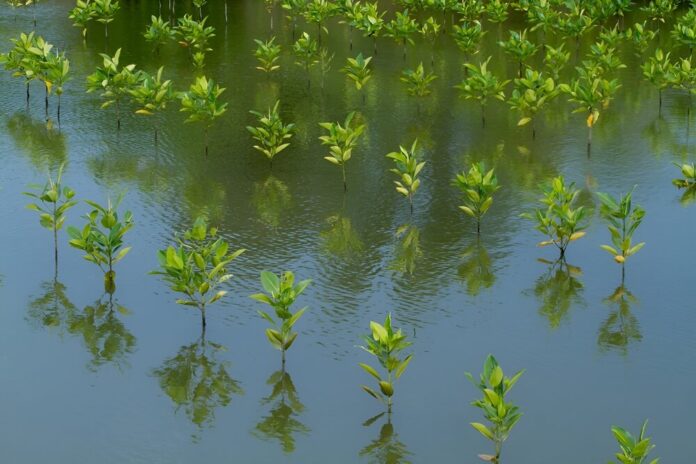
Ecobiz.asia — Gold Standard has issued its first-ever Design Certification for a blue carbon project, granting the status to the Global Mangrove Trust Blue Carbon Restoration Project – Sumatra 1 in Indonesia.
The certification was announced via Gold Standard’s official social media channels on Wednesday (Feb. 25, 2026).
Located across four villages in North Sumatra, the microscale project aims to restore and conserve 142.82 hectares of degraded mangrove forest. During its crediting period, the project is estimated to generate carbon removals of around 6,000 tonnes of CO₂ equivalent (tCO₂e) per year.
Design Certification is an early-stage approval under the Gold Standard for the Global Goals framework. It confirms that a project’s design—covering methodology, emissions accounting, monitoring plans, and environmental and social safeguards—meets Gold Standard’s requirements for scientific robustness, transparency, and integrity.
Projects must still undergo validation, verification, and issuance processes before carbon credits can be issued.
The Sumatra 1 project is implemented by local non-governmental organisation Yayasan Gajah Sumatra (Yagasu) and managed by Global Mangrove Trust. Global Mangrove Trust is also leading the development of a country-wide Gold Standard Programme of Activities to scale up mangrove restoration across Indonesia.
Gold Standard highlighted the project as an example of high-integrity blue carbon in practice, combining science-based restoration, prioritisation of native mangrove species, and close collaboration with local communities.
Mangrove ecosystems are widely recognised as one of the most effective nature-based climate solutions, due to their capacity to sequester and store large amounts of carbon while supporting biodiversity, protecting coastlines, and sustaining coastal livelihoods.
The milestone is seen as a significant step in expanding credible nature-based finance, as investors and carbon markets increasingly demand projects with measurable climate impact and strong environmental and social safeguards. ***