

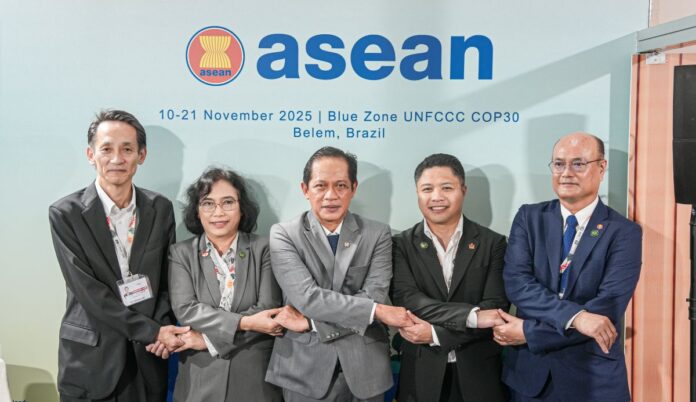
Ecobiz.asia — Indonesia called on Southeast Asian nations to accelerate their collective push toward net-zero emissions and advance regional carbon market integration during a high-level ASEAN session at the UN Climate Change Conference (COP30).
Speaking at the ASEAN Pavilion in Belém, on Thursday, (Nov.13, 2025)Indonesia’s Minister of Environment Hanif Faisol Nurofiq said the region must strengthen coordinated climate action to keep pace with global decarbonisation efforts.
“ASEAN must present itself as a collective force in developing an inclusive, transparent and high-integrity carbon market. Indonesia is committed to ensuring every tonne of carbon traded can be traced and verified,” Hanif said.
The session, titled Accelerating Substantial Actions of Net Zero Achievement through Enhanced Cooperation in ASEAN, was co-hosted by the ASEAN Secretariat and GIZ, with participation from Japan, Brunei Darussalam and Indonesia’s Ministry of Forestry.
Indonesia highlighted its recent regulatory overhaul under Presidential Regulation No. 110/2025, which expands the national carbon trading framework and enables cross-border transactions.
The country has also signed Mutual Recognition Agreements (MRAs) with five major crediting standards to support high-integrity trading.
At COP30, Indonesia also introduced the “Carbon Connection for Climate Action” platform aimed at boosting regional and global collaboration across carbon markets.
Japan’s Vice-Minister for Environment, Doi Kentaro, reaffirmed Tokyo’s support through the long-running Joint Crediting Mechanism (JCM), noting that a dedicated JCM Implementation Agency will be launched in 2025. He emphasised the need for stronger private-sector engagement.
Brunei Climate Change Secretariat Chair Ahmad Zaiemaddien underscored the importance of circular economy initiatives and scaling up climate finance across ASEAN.
Agus Budi Santosa, Director of Forest Resource Inventory and Monitoring at Indonesia’s Ministry of Forestry, said carbon market integration would create new mitigation opportunities for the region. He proposed establishing a regional platform to standardise carbon methodologies and safeguard market integrity, particularly for forestry-based credits. ***