
Ecobiz.asia — Indonesia’s Ministry of Marine Affairs and Fisheries (KKP) has outlined the mechanism for blue carbon trading, emphasizing the need to integrate marine spatial permits, carbon registry systems, and strict oversight to safeguard national climate targets.
Marine Affairs and Fisheries Minister Sakti Wahyu Trenggono said all carbon mitigation activities must be supported by Marine Spatial Utilization Permits (PKKPRL) as a key legal prerequisite, alongside registration in the Carbon Unit Registry System (SRUK).
“Every carbon mitigation action must have a PKKPRL as a primary requirement for project site legality. We are working in synergy with the Ministry of Environment to implement the SRUK. All climate action design documents must be registered to ensure Indonesia’s blue carbon data sovereignty and prevent double counting,” he said in a statement on Sunday (April 19, 2026).
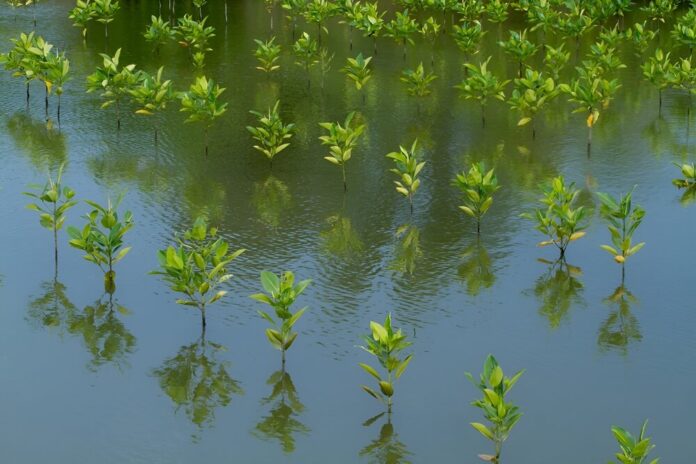
Trenggono said Indonesia’s blue carbon ecosystems have the potential to absorb up to 10 million tonnes of CO₂ equivalent annually. Mangrove ecosystems, covering 997,733 hectares, are projected to absorb around 6.36 million tonnes of CO₂ equivalent per year, while seagrass ecosystems spanning 660,156 hectares could absorb approximately 3.78 million tonnes annually.
He added that in line with the national implementation of Carbon Economic Value (NEK), the ministry is focusing on three main pillars, ranging from regulatory development to project pipeline preparation.
“On the regulatory side, KKP is currently drafting technical regulations as a follow-up to Presidential Regulation No. 110 of 2025,” he said.
The ministry has also developed carbon trading procedures aligned with the regulation, ensuring that the economic value of carbon delivers tangible and sustainable benefits for the state and coastal communities.
In addition, KKP is strengthening data and information systems, including mapping blue carbon ecosystem areas, establishing emission baselines, and calculating carbon absorption potential.
The ministry is also preparing a pipeline of projects as part of on-the-ground implementation, including pilot blue carbon restoration initiatives and emission reduction programs in the fisheries sector. ***