
Ecobiz.asia – Indonesia broke ground on the Legok Nangka waste-to-energy plant in West Java, the country’s first waste-to-energy project developed under a public-private partnership (PPP) scheme, supported by Japan’s Joint Crediting Mechanism (JCM) carbon financing.
The approximately US$400 million project combines government support, international climate finance and private investment to accelerate Indonesia’s efforts to tackle urban waste while expanding renewable energy capacity.
The project received US$46 million in financing through Japan’s JCM, complemented by €35 million in international investment and a Rp1.34 trillion (around US$82 million) Viability Gap Fund provided by Indonesia’s Ministry of Finance.
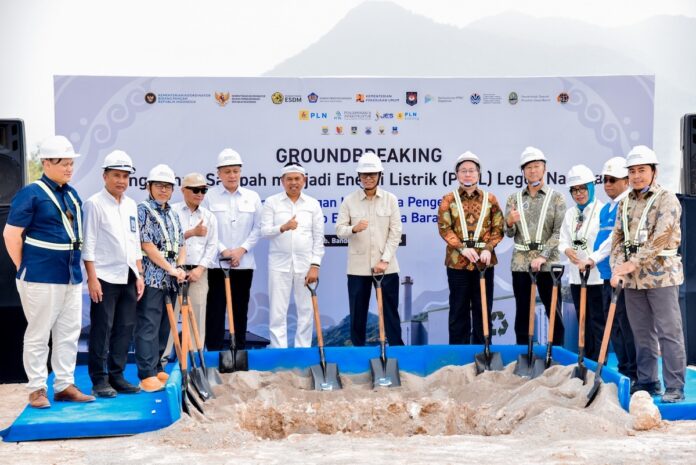
Deputy Minister of Energy and Mineral Resources Yuliot Tanjung officially launched construction during a groundbreaking ceremony at the Legok Nangka Regional Waste Processing and Final Disposal Facility in Bandung Regency, Wednesday (July 29, 2026).
“Today’s groundbreaking is not merely the start of infrastructure construction. It symbolizes our shared commitment to building a cleaner, greener and more sustainable Indonesia,” Yuliot said.
The Legok Nangka facility is designed to process between 1,853 and 2,131 metric tons of municipal waste per day collected from six municipalities and regencies across West Java, including Bandung City, Cimahi, Bandung Regency, West Bandung, Sumedang and Garut.
Once operational, the facility is expected to generate 40.79 megawatts of electricity while reducing greenhouse gas emissions by approximately 311,874 tonnes of CO₂ equivalent annually.
Construction is expected to take around 41 months, with commercial operations targeted for 2029.
Yuliot said the project supports President Prabowo Subianto’s directive to comprehensively address Indonesia’s urban waste challenge before 2029 by promoting integrated waste management and converting waste into energy.
“We expect construction to be accelerated so the facility can begin operations earlier. This will require continued commitment from the central and regional governments, PLN, project developers, financial institutions and local communities,” he said.
He also acknowledged the West Java provincial government for supporting the project and welcomed the participation of Japanese companies Sumitomo Corporation and Hitachi Zosen Corporation, which are partnering with Indonesian firm PT Energia Prima Nusantara.
The project is being developed by PT Jabar Environmental Solutions (PT JES) under Indonesia’s PPP framework, making it the country’s first waste-to-energy project financed through this mechanism.
West Java Governor Dedi Mulyadi said the plant would provide three key benefits: reducing the region’s mounting waste problem, supplying electricity for households and industry, and improving environmental quality.
During construction, the project is expected to create around 1,565 jobs, while supporting Indonesia’s broader strategy to expand renewable energy and reduce dependence on landfills as part of its national decarbonization agenda. ***