
Ecobiz.asia – Indonesia has begun preparing its second and third Biennial Transparency Reports (BTR2 and BTR3) to report progress on climate action, including greenhouse gas (GHG) emissions reductions, to the international community.
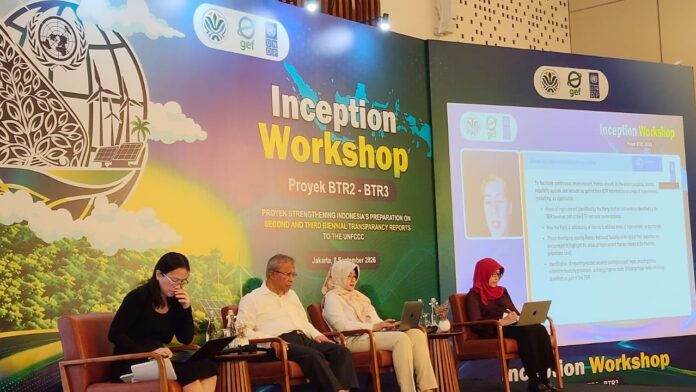
The Ministry of Environment/Environmental Control Agency (KLH/BPLH) kicked off the preparation of the reports through a BTR2-BTR3 project workshop in Jakarta on Tuesday (Sept. 8, 2026), bringing together representatives from government ministries and agencies, academia, civil society organisations and development partners, including the United Nations Development Programme (UNDP).
Deputy for Climate Change Control and Carbon Economic Value Governance at KLH/BPLH Ary Sudjianto said the BTR provides a mechanism for Indonesia to report progress on climate action while meeting its transparency obligations under the Paris Agreement.
“The report is part of Indonesia’s commitment to meeting its climate transparency obligations and provides an overview of the progress that has been achieved,” Ary said.
The BTR will contain key information on Indonesia’s climate action, including GHG emissions data, progress in emissions reductions and the country’s progress toward its national climate targets under its Enhanced Nationally Determined Contribution (ENDC).
The reports will also provide information on international support received by Indonesia for climate change mitigation and control programmes through 2024.
Indonesia submitted its first BTR to the United Nations Framework Convention on Climate Change (UNFCCC) in 2024. Under the Paris Agreement transparency framework, countries are required to submit such reports every two years.
Emissions Data to Be Updated Through 2024
KLH/BPLH is coordinating the preparation of BTR2 and BTR3 as Indonesia’s official focal point with the UNFCCC. The process is being carried out with UNDP support and financed by the Global Environment Facility (GEF).
The project is intended to help Indonesia prepare climate transparency reports in accordance with international standards under the Paris Agreement. It involves multiple stakeholders to ensure the data submitted are accurate, comprehensive and accountable.
Mitta Ratna Djuwita, director of GHG Inventory and Measurement, Reporting and Verification (MRV) at KLH/BPLH, outlined the project and the direction of Indonesia’s transparency reporting.
Rizaldi Boer of the Center for Climate Risk and Opportunity Management (CCROM) at IPB University explained the scope of BTR2, including updates to Indonesia’s national emissions data for 2000-2024, improvements to the report and alignment with international requirements.
From the international cooperation side, UNDP Regional Technical Advisor Natalia Vasyilvena outlined UNDP’s support for the project, including monitoring and evaluation.
UNDP Gender Focal Point Agnes Gurning said gender equality would also be incorporated into the reporting process and climate agenda to help ensure policies and programmes reach different groups in society. ***